
WHY BIOLOGICALSARE BECOMING AN INFORMATION SCIENCE
- BioPrime Stories & latest news

- WHY BIOLOGICALSARE BECOMING AN INFORMATION SCIENCE
WHY BIOLOGICALSARE BECOMING AN INFORMATION SCIENCE
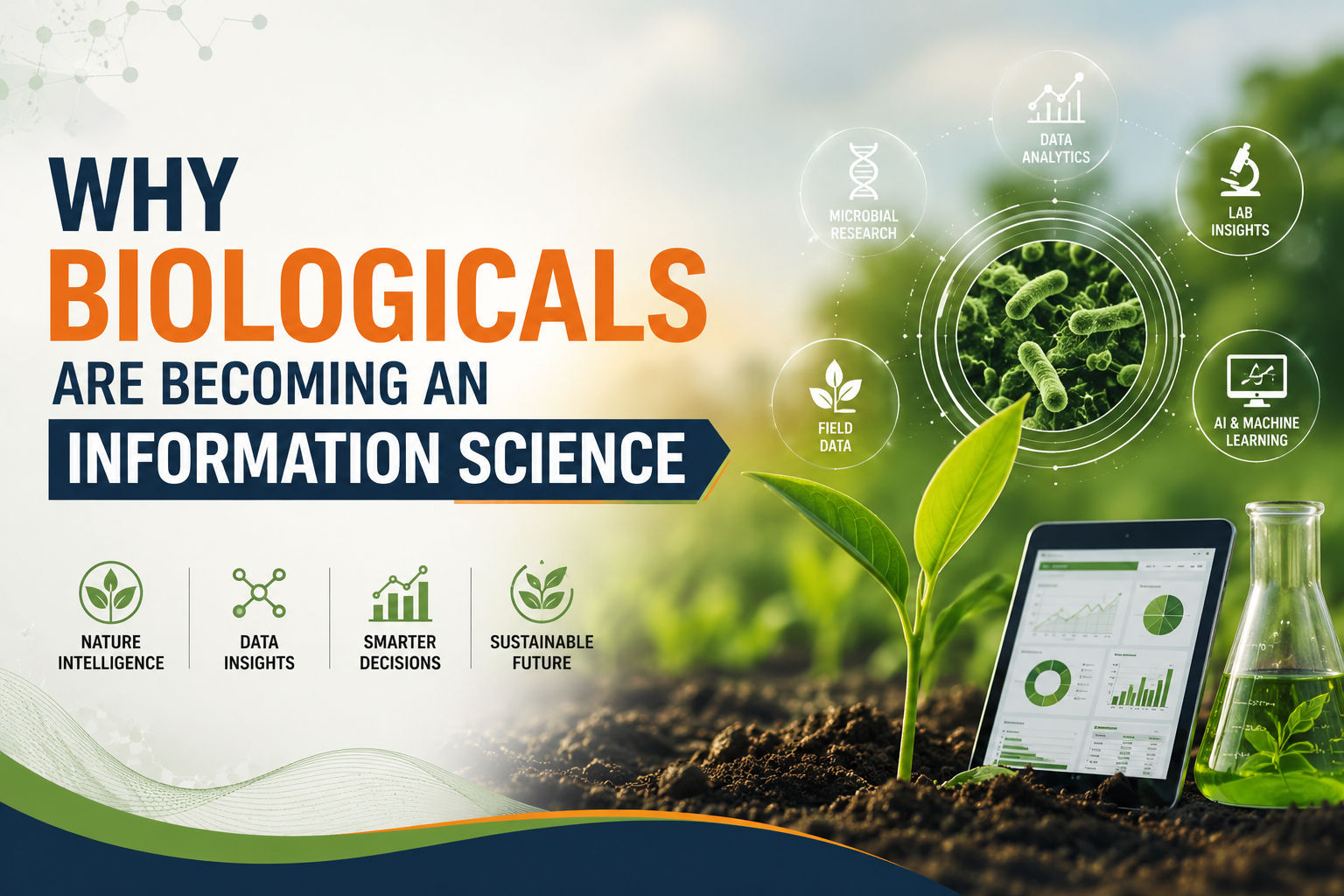
Agriculture didn't just get more precise. It got fluent — in a language the soil was always speaking.
There's a quiet way to tell the story of agriculture that has nothing to do with tractors, GMOs, or fertilizer subsidies. It's a story about what a farmer actually knows at the moment they make a decision — and how the unit of that knowledge has changed, twice, in ways that quietly rewired the entire discipline.
The first change was about substance. The second was about data. The third — the one now underway — is about signal. And it's the most consequential shift of the three, because it isn't just giving us a better view of biology. It's teaching us to read a language biology has been speaking, uninterrupted, for over 400 million years.
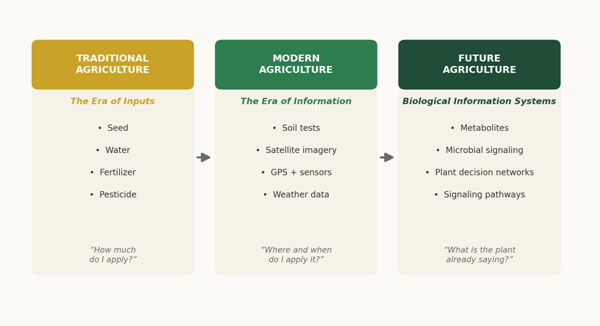
The three eras of agriculture: from applying substances, to optimizing data, to reading and eventually speaking a biological language.
Traditional Agriculture: The Era of Inputs
For most of agricultural history, farming was fundamentally a materials problem. You had a plant, and a short list of things it might need: water, nitrogen, phosphorus, potassium, protection from whatever was eating it. The farmer's expertise lived almost entirely in judgment about substance and quantity — how much manure, how much water, how much powder to dust across the leaves.
Inputs were applied reactively, and mostly undifferentiated across a field. A yellowing leaf meant more nitrogen. Visible pest damage meant a spray. By the time either symptom was visible to the human eye, weeks of yield potential were already gone — because the plant had been signaling distress in its own chemistry long before it showed up as a color change a person could see.
This wasn't a failure of farmers. It was a hard ceiling imposed by the tools available. You could see a leaf. You could not see a metabolite.
Modern Agriculture: The Era of Information
Precision agriculture changed the fundamental unit of value from substance to data. Soil testing told growers what was actually in the ground before they had to guess. Satellite and drone imagery revealed canopy stress before it was visible to the human eye. GPS-guided variable-rate equipment meant fertilizer could be metered zone by zone across a single field, rather than blanket-applied everywhere at the same rate.
The shift here was real and valuable: farming became an optimization problem over information, not just a materials problem. The question changed from “how much” to “where, when, and how precisely.”
But precision agriculture, for all its sophistication, has a quiet limitation that rarely gets named: nearly all of that information is measured from outside the plant. Sensors, satellites, and soil probes describe the visible consequences of biology — canopy color, moisture content, nutrient concentration — without ever reading the internal conversation that produced those consequences. We became excellent at monitoring biology's outputs. We still weren't reading its language.
Future Agriculture: Biological Information Systems
The transition now underway is different in kind, not just in degree. Genomics, metabolomics, and microbiome sequencing have made it possible, for the first time, to actually read the chemical vocabulary that plants, microbes, and soil have used to communicate with each other for hundreds of millions of years. This is the pivot from monitoring biology to decoding it — and, eventually, to speaking back in the same language.
Because it turns out the rhizosphere — the thin zone of soil immediately around a root — was never a passive substrate waiting to be fed. It was always a network exchanging information. We simply lacked the instruments to parse the chemistry it was written in.
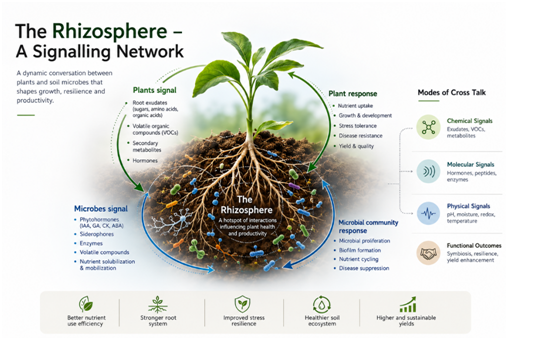
A continuous, two-way exchange of chemical messages between root and microbiome — not a one-way delivery of nutrients.
Metabolites as Signals
Root exudates were, for a long time, treated as little more than leakage — metabolic waste seeping out of the root. We now understand them as deliberate chemical messaging. A plant routes as much as 20–40% of the carbon it fixes through photosynthesis directly out through its roots, into the soil, as a cocktail of sugars, amino acids, organic acids, and secondary metabolites — and the composition of that cocktail changes depending on what the plant needs.
Under phosphorus limitation, plants shift their exudate profile toward specific organic acids — citrate, malate — that do two things at once: chelate bound phosphorus directly, and selectively recruit the phosphate-solubilizing microbial populations best equipped to help. Under insect attack, many plants release specific volatile organic compounds that recruit the natural enemies of the exact pest damaging them; classic work on maize seedlings, for instance, showed caterpillar feeding triggers a volatile signal that draws in the parasitic wasps that prey on that specific caterpillar species. That is not a generic stress response. It is a targeted distress signal, addressed to a specific responder.
Strigolactones make the case most clearly. This is a class of plant hormone exuded directly from roots, whose job is to recruit arbuscular mycorrhizal fungi specifically when phosphorus is scarce — a chemical “help wanted” notice, broadcast into the soil, tuned to attract one particular class of biological ally.
Microbial Communication
Soil microbes don't behave as a bag of independent organisms each reacting individually to their surroundings. Bacteria talk to each other continuously through a mechanism called quorum sensing: releasing small signaling molecules, called autoinducers, whose ambient concentration reports local population density back to the whole community.
Only once that concentration crosses a threshold do bacteria collectively switch behavior — forming a biofilm, switching on nutrient-scavenging enzymes, or, in pathogens, triggering coordinated virulence all at once rather than piecemeal. It is, functionally, a distributed communication protocol with a quorum threshold — not unlike the handshake and acknowledgment logic that governs how nodes agree to act together in a computer network.
This matters enormously for how biological products actually work in the field. A beneficial microbial strain introduced into soil is never acting alone — its behavior is constantly being negotiated against the quorum signals of whatever community is already established there. Understanding a strain's real-world efficacy means understanding the conversation it is having with everything else already present, not just its performance in isolation on an agar plate.
Plant Decision-Making
None of this is metaphor or anthropomorphism. Plants continuously integrate dozens of simultaneous internal and external signals — light quality, nutrient status, internal hormone levels, the chemical signature of neighboring roots, herbivore damage, the presence or absence of specific microbes — and produce a coherent, prioritized output: grow the root this direction, not that one; close this stomate; reallocate carbon toward defense compounds instead of growth; abort this flower to protect three others.
That is a decision, arrived at through signal integration — even though there is no brain doing the deciding. It's telling that systems biologists increasingly describe plant hormone networks explicitly in the vocabulary of information processing: signal transduction, feedback loops, thresholds, cross-talk between pathways. The language of computation turns out to be a remarkably good fit for what a plant is actually doing, moment to moment, underground and out of sight.
Signaling Pathways
The legume–rhizobium symbiosis is the textbook example, and it rewards a close look because it is, quite literally, a molecular handshake protocol. A legume root exudes specific flavonoid compounds into the surrounding soil. Compatible rhizobium bacteria detect those flavonoids and respond by synthesizing a corresponding Nod factor — a precisely structured signaling molecule. The plant's root hair recognizes that exact molecular structure (and rejects incompatible ones from the wrong bacterial species), curls around the bacterium, and initiates the formation of a nodule to house it.
Each side is confirming the other's identity through a precisely shaped chemical exchange before committing any resources — not unlike two systems authenticating each other before agreeing to exchange data. It is a protocol, evolved rather than engineered, but a protocol nonetheless.
Layered on top of that external signaling is an equally intricate internal messaging network: auxins directing growth polarity, jasmonates triggering defense responses, ethylene coordinating ripening and stress response, abscisic acid managing drought response. Every one of these pathways is, in the most literal sense, a system for encoding a condition into a molecule, transmitting it, and triggering a specific, proportionate response elsewhere in the plant.
Reading the Language, Not Just the Weather
This is precisely the layer BioPrime's SNIPR platform is built to work in. Not formulating another blunt-force input to apply in greater volume, but discovering the specific bioactive molecules and metabolites that function as precise signals — the ones that call in phosphate solubilizers exactly when a crop needs them, that prime a plant's own defense pathways before a pathogen arrives, that speak the exact chemical dialect a particular crop–microbe relationship has already evolved to understand.
Paired with BioNexus, one of India's largest plant-associated microbiome libraries, the work stops looking like product formulation and starts looking like assembling a vocabulary — matching the right molecular message to the right biological conversation, crop by crop, soil by soil, stress by stress.
This is the throughline connecting to every metabolite explored in this series so far. Each one isn't just a compound with a promising assay result. It's a word in a language that plants and microbes have been speaking to each other since long before agriculture existed — and one we are, for the first time in history, actually learning to read.
The Next Fluency
Agriculture didn't arrive at this moment by accident. First it was a materials problem, solved with substance. Then it was an optimization problem, solved with data. Now, for the first time, we have the instruments to treat it as what it secretly was all along: an information system, with its own chemistry, its own protocols, and its own decisions being made every second in every handful of soil.
The next generation of agricultural science won't be defined by molecules, or software alone. It will be defined by biological information companies — fluent enough in this language to read what a stressed root is already broadcasting, and to answer back in a signal the plant and its microbiome already know how to trust.