
WHAT IF PLANTS COULD TELL US WHAT THEY NEED?
- BioPrime Stories & latest news

- WHAT IF PLANTS COULD TELL US WHAT THEY NEED?
WHAT IF PLANTS COULD TELL US WHAT THEY NEED?
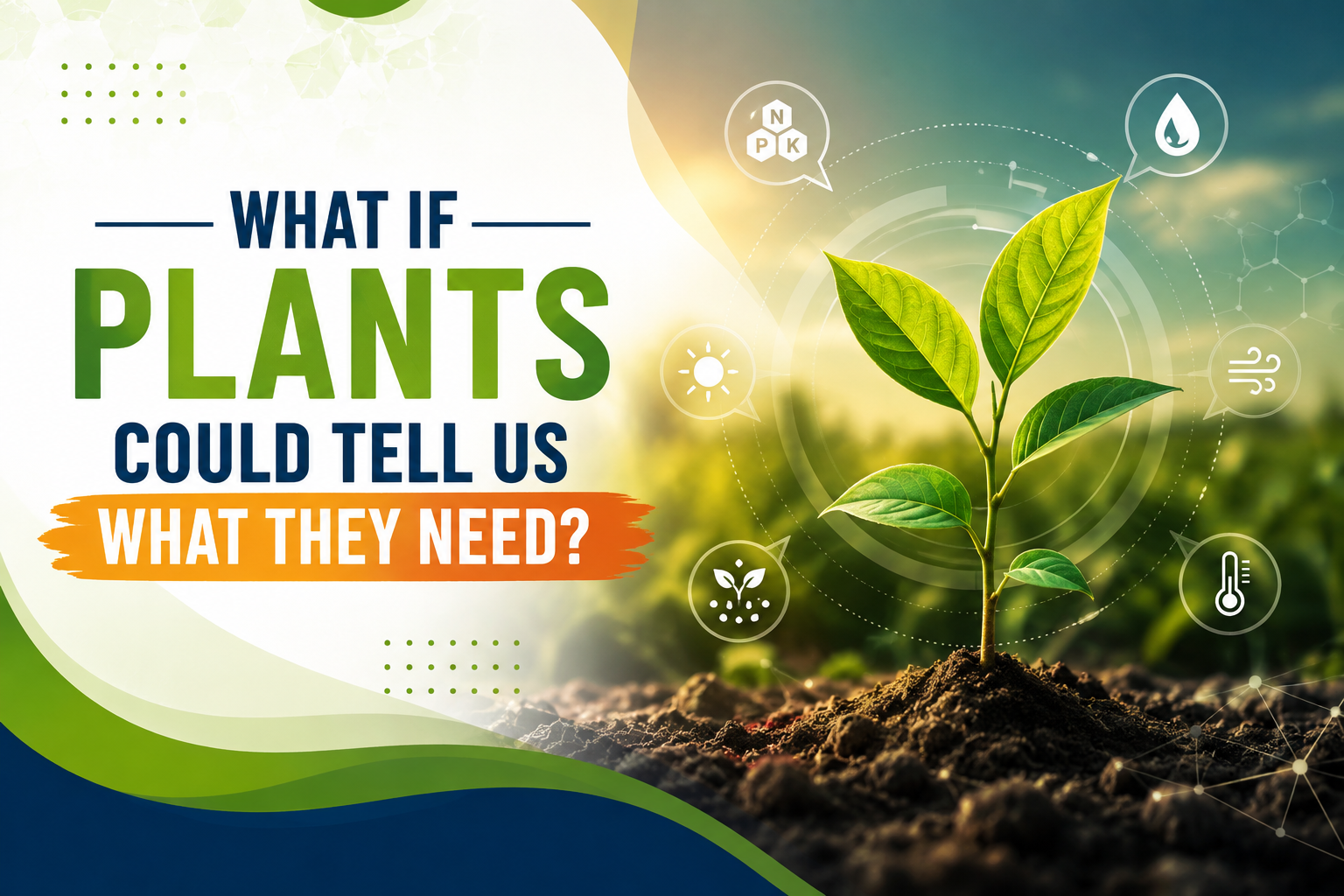
The future of agriculture lies in listening to plants
Imagine walking through your field and knowing exactly what every plant needs. Knowing whether plants needs more fertilizer or water or that stress or diseases have begun creeping up -long before any visible symptoms show up.
Would agriculture look different? Almost certainly. Because today we manage fields based on symptoms. Tomorrow — and this is not science fiction, it's already underway in research labs — we will manage them based on biological signals.
Here's the part that should genuinely change how you look at a field: plants already say all of this. Continuously, in real time, in a chemical and electrical language that has existed for hundreds of millions of years. The challenge was never that plants are silent. The challenge is that we haven't learned to listen properly.
Plants Are Constantly Talking
At every moment, a plant is broadcasting information through channels most of us were never taught to notice: hormones, metabolites, electrical signals, volatile compounds, root exudates, and shifts in gene expression. None of this is random noise. Each of these is a structured, biologically meaningful message — the plant's own reporting system, running whether or not anyone is reading it.
A few translations, once you know what to look for:
- Leaves curl → a water-deficit signal, often appearing before the plant's water status becomes critical.
- Anthocyanin accumulates (that reddish-purple tint) → frequently a visible marker of phosphorus deficiency, as the plant's own stress-response pigments build up.
- Root exudates change composition → a deliberate shift to recruit the specific microbes best suited to the plant's current nutrient shortfall.
- Terpenoid output increases → a chemical alarm, often released specifically to attract the natural predators of whatever insect is currently feeding on the plant.
- A reactive oxygen species (ROS) burst occurs → one of the earliest detectable stress signals, often propagating systemically across the whole plant within minutes of a localized threat.
Every one of these is legible, once you know the alphabet. The problem has never been a lack of information. It's that most of agriculture has been trained to read only the very last, loudest sentence in a very long conversation.
Stress Starts Long Before We Can See It
This is the section worth sitting with the longest, because it reframes what “early intervention” actually means.
Farmers see yellowing leaves, flower drop, wilting, or disappointing fruit size. Those are real signals — but they are also the final chapter of a story that began much earlier. By the time a symptom is visible to the human eye, the plant has typically already moved through several earlier, invisible stages: near-instant perception of the stressor at the cellular level, a fast-moving systemic wave of reactive oxygen species and electrical signaling that alerts the rest of the plant within minutes, a hormonal reprogramming that unfolds over the following hours, and a deeper shift in gene expression and metabolism over the following days — all of it well underway before a single visible symptom appears.
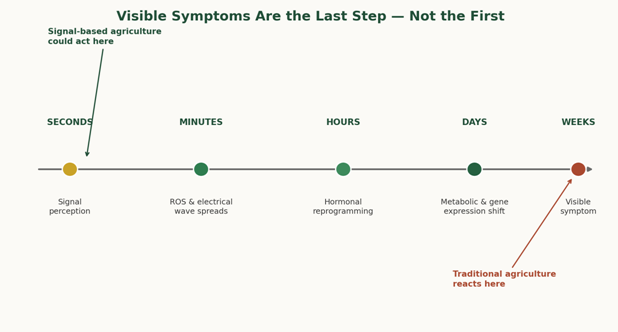
Visible symptoms are the last, latest step in a cascade that begins seconds after the plant first perceives a stressor.
Agriculture today, almost universally, treats the symptom — the last box in that sequence. Future agriculture will respond to the signal — several boxes earlier, while there's still time to change the outcome rather than simply document it.
Every Plant Has Thousands of Sensors
It's easy to think of a plant as a relatively passive organism, rooted in place, waiting for whatever the environment delivers. The physiology tells a very different story. A single plant continuously senses temperature, light spectrum (not just light presence — the specific ratio of wavelengths), humidity, mechanical touch, gravity, physical obstacles in the soil around its roots, the proximity and identity of neighboring plants, the presence of specific microbes, nutrient gradients, and water potential — all at once, all the time.
None of these signals are processed in isolation. A plant continuously integrates all of them together before arriving at a physiological decision — which is a remarkable amount of real-time environmental computation happening in an organism most of us walk past without a second thought.
Plants Continuously Make Decisions
This is the heart of the reframe. Every day, a plant is deciding: should I grow roots here, or leaves there? Should I flower now, or wait? Should I mount a defense response, or conserve energy instead? Should I invest carbon into feeding a microbial partner, or hold onto it? Should I produce more flavonoids? Activate antioxidants? Close my stomata against water loss, even at the cost of slower photosynthesis?
Plants are not passive dispensers of yield, quietly waiting for the right combination of inputs. They are continuously optimizing for survival — and yield, when it happens, is the visible byproduct of thousands of these small, mostly invisible decisions, made correctly, in sequence, across an entire season.
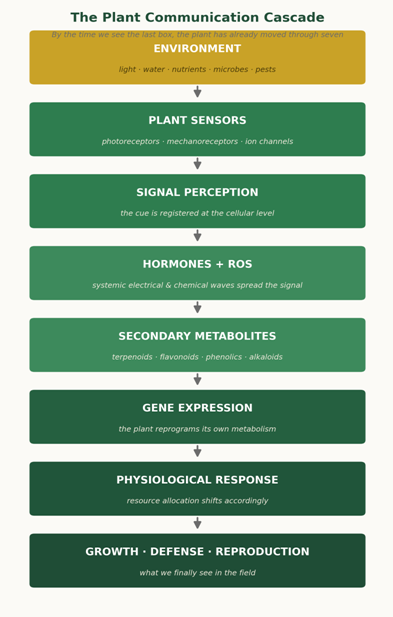
The plant communication cascade: by the time we observe growth, defense, or reproduction, the plant has already moved through seven earlier stages.
Secondary Metabolites Are Messages
Terpenoids, flavonoids, phenolics, alkaloids — as explored elsewhere in this series, these are not simply compounds a plant happens to produce. They are information carriers, each one coordinating a specific function: defense, communication with neighboring plants, resource allocation, microbial recruitment, or a signal broadcast outward to whatever — insect, fungus, bacterium — might be listening on the other end.
Reading a plant's metabolite profile, in other words, isn't just chemistry. It's closer to reading its diary.
The Rhizosphere Is a Conversation
Roots release sugars, flavonoids, organic acids, phenolics, and coumarins into the soil around them. Microbes respond. The plant adjusts its exudates again in response to that response. Nutrient availability shifts. The plant adjusts once more. This conversation never pauses — not for a single hour of a single day, in every square centimeter of root zone on the farm.
The soil, in other words, is not dirt. It is a living communication network, running a continuous negotiation between root and microbiome — one we've explored in more depth elsewhere in this series, and one that never once goes quiet, even when nothing is visibly happening above ground.
What If Agriculture Could Listen?
This is where the entire framing of farming decisions could shift. Traditional agriculture asks a fairly blunt question: what should I apply? Future agriculture asks a much more precise one: what is the plant actually asking for?
|
Traditional question |
What's often really happening |
The more precise question |
|---|---|---|
|
“Do I need more nitrogen?” |
The plant may have enough nitrogen but poor assimilation efficiency |
“Is nitrogen being taken up and converted efficiently?” |
|
“Do I need more phosphorus?” |
The phosphorus may already be present but chemically locked in the soil |
“Is the plant signaling for help mobilizing what's already there?” |
|
“Do I need more pesticide?” |
The plant's own defense pathways may already be activating |
“Is the plant's defense response being supported, or overridden?” |
The challenge was never that plants are silent. It's that we haven't learned to listen properly.
This Is Where Biology Changes Agriculture
BioPrime doesn't start from the question of which product to formulate next. It starts further back — studying plant signaling, secondary metabolites, root-microbe interactions, and physiological stress responses as the actual subject matter, with formulated products as one of the outputs of that understanding rather than the starting point.
This is the distinction that matters. A product built to override a symptom fights the plant's own physiology to get a result. A solution built from an understanding of what the plant is already signaling — what it's already trying to do — works with that physiology instead of against it. That's a fundamentally different design principle, and it's the one this kind of biological understanding makes possible.
Looking Ahead
The future farm may not begin with a fertilizer recommendation. It may begin with a biological diagnosis. Not “what does the soil contain?” but “what is the plant experiencing, right now, before any of it becomes visible?”
When agriculture gets consistently good at answering that second question, farming shifts from reactive management to something closer to predictive biology — acting on what a plant is already telling us, days or weeks before a yellowing leaf ever forces the conversation.
Perhaps the next revolution in farming was never going to be about teaching plants how to grow. It is finally learning how to listen.