
ONE GRAM IN 100 TONNES
- BioPrime Stories & latest news

- ONE GRAM IN 100 TONNES
ONE GRAM IN 100 TONNES
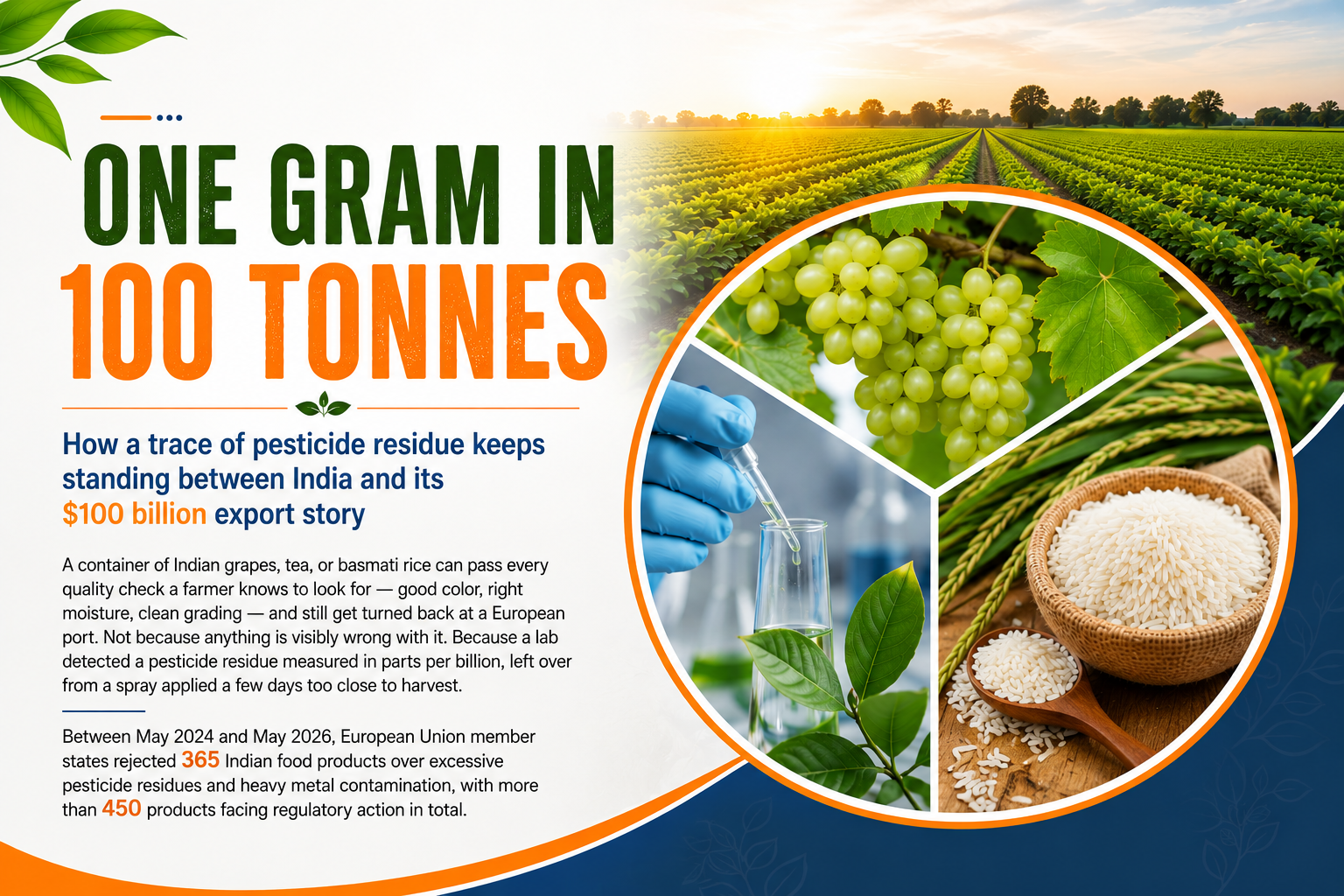
How a trace of pesticide residue keeps standing between India and its $100 billion export story
A container of Indian grapes, tea, or basmati rice can pass every quality check a farmer knows to look for — good color, right moisture, clean grading — and still get turned back at a European port. Not because anything is visibly wrong with it. Because a lab detected a pesticide residue measured in parts per billion, left over from a spray applied a few days too close to harvest.
Between May 2024 and May 2026, European Union member states rejected 365 Indian food products over excessive pesticide residues and heavy metal contamination, with more than 450 products facing regulatory action in total. This isn't a fringe problem. It's a recurring, well-documented pattern sitting directly between India's current agricultural export base of roughly $51.2 billion and the government's own target of pushing that figure toward $100 billion.
What's Actually Getting Rejected — And Why
Two contaminants dominate the recent rejection data more than any others.
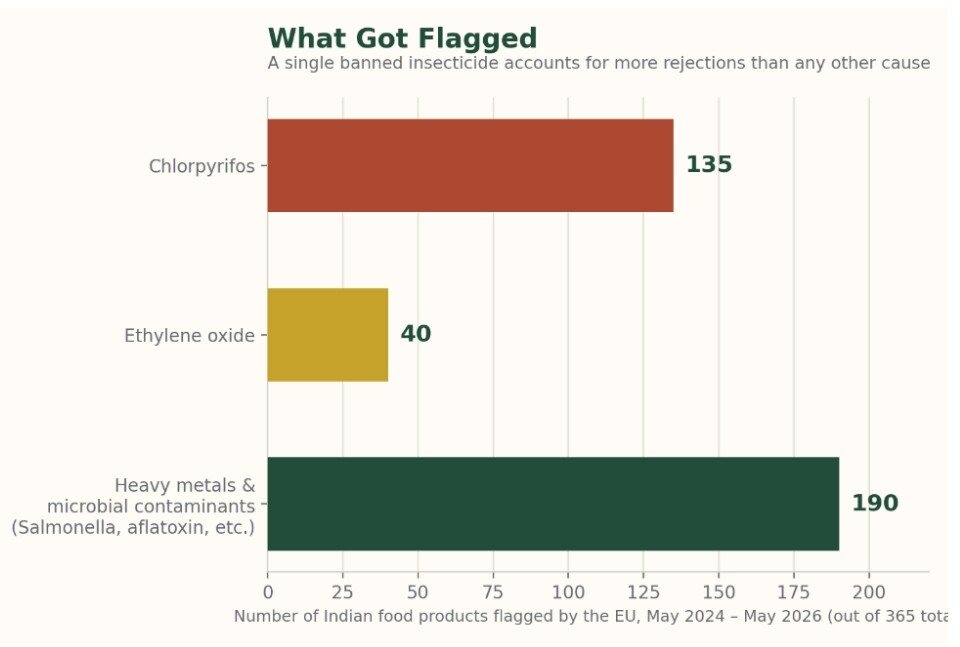
Chlorpyrifos and ethylene oxide together account for nearly half of all 365 EU rejections of Indian food products, May 2024 – May 2026.
Chlorpyrifos — an insecticide banned in the EU since April 2020 — was found in roughly 135 of the 365 flagged products. EFSA's own 2024 residue monitoring report confirms India among the countries of origin with the highest chlorpyrifos findings globally, detected across commodities including table grapes, rice, and cumin seed. Ethylene oxide, a fumigant used to sterilize spices against microbial contamination, appeared in around 40 products — the same contaminant that triggered a continent-wide recall crisis in European spice supply chains back in 2020. The remainder of the rejections span heavy metals (lead, mercury) and microbiological hazards including Salmonella, aflatoxin B1, and ochratoxin A.
The Problem, Crop by Crop
Residue issues aren't evenly spread across Indian agriculture — they cluster hard around a handful of export-critical crops, each with its own recurring chemical signature.
|
Crop |
Chemicals most flagged |
Recurring pattern |
|---|---|---|
|
Basmati & non-basmati rice |
Tricyclazole, thiamethoxam, chlorpyrifos, imidacloprid |
Over 200 EU rapid-alert notifications in five years — largely fungicide/insecticide use with no EU import tolerance |
|
Table grapes |
Chlormequat chloride, chlorpyrifos |
A plant growth regulator widely used in India but historically unregulated for MRL purposes — caused a multi-crore rejection crisis |
|
Spices (cumin, chilli, pepper) |
Chlorpyrifos, ethylene oxide, tricyclazole, thiamethoxam |
Fumigation for microbial safety collides with pesticide residue limits simultaneously |
|
Tea (Assam, Darjeeling) |
Thiamethoxam, clothianidin, thiacloprid, acetamiprid |
Revised EU MRLs for neonicotinoids threaten ~40 million kg of Assam tea exports to the EU/UK alone |
What's notable across every one of these rows: almost none of these chemicals are being used illegally by Indian standards. Most are approved, registered products, applied for a genuine pest or disease problem. The failure point is almost always timing, dose, or a regulatory gap between what India permits and what the destination market allows — not a farmer deliberately cutting corners.
Why This Keeps Happening
The clearest case study is chlormequat chloride on grapes. It's a growth regulator recommended in India to help grapevines set fruit buds, typically applied around 45 days after pruning. For years, its use wasn't specifically regulated in India, and no Indian dossier had ever been submitted to establish an EU import tolerance — so when EU labs found it, the default detection threshold of 0.05 ppm applied automatically, and consignments were rejected outright. It wasn't that the fruit was unsafe by any measured standard; it was that nobody had done the regulatory paperwork connecting Indian agricultural practice to European import law.
Three structural issues repeat across almost every rejected shipment:
- PHI is treated as a formality, not a hard deadline. The gap between spraying and harvest often gets compressed under market or weather pressure, even when the product label clearly states a waiting period.
- India's registered-use list and the EU's approved-substance list don't match. A pesticide can be fully legal and commonly used in India while carrying zero import tolerance in the EU — meaning any detectable trace, regardless of concentration, triggers rejection.
- Fragmented, smallholder supply chains make traceability hard. When produce from hundreds of small farms is pooled before export, a single grower's misapplied spray can contaminate an entire consignment, and there's often no batch-level way to isolate where it came from.
If Residues Are to Be Avoided, How Many Days Before Harvest Should the Last Spray Stop?
There's no single universal number — the pre-harvest interval (PHI) is specific to each pesticide-crop combination, and it's printed directly on the product label as a legal requirement, not a suggestion. But the pattern across common Indian crop-protection products is informative:
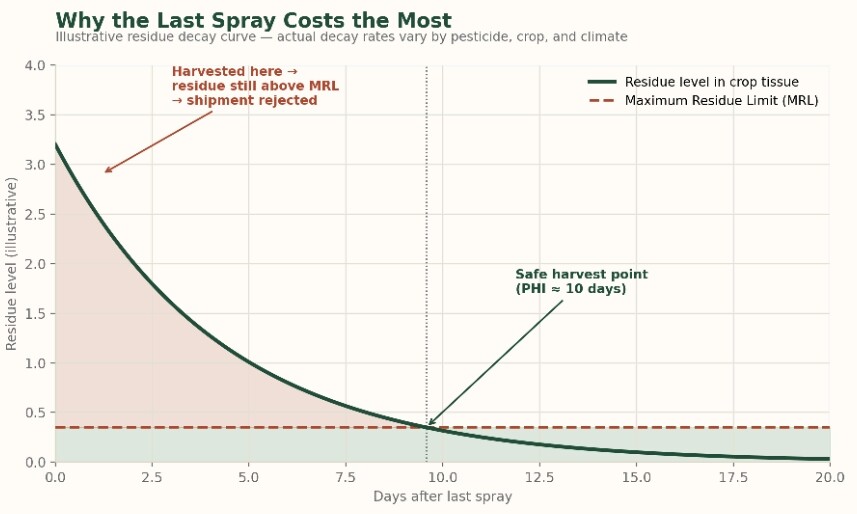
An illustrative residue decay curve: harvesting before the residue level drops below the Maximum Residue Limit is what triggers rejection — actual decay rates vary by pesticide, crop, and climate.
- Tricyclazole on rice/green chilli: commonly labelled with a 12–24 day PHI depending on formulation and dose — several Indian product labels explicitly warn it is not suitable for Basmati intended for EU export, given the bloc's 0.01 ppm default limit.
- Most common insecticides and fungicides on fruiting vegetables: PHIs generally range from 3 to 21 days, with some systemic products requiring longer.
- Chlormequat chloride on grapes: recommended for application roughly 45 days after pruning — problems arose specifically when applied later than that window, closer to harvest.
The rule that matters more than any specific number: the label is the legal document. India's Central Insecticides Board & Registration Committee (CIB&RC) sets the waiting period for every registered pesticide-crop combination as part of the registration process itself — it isn't a recommendation layered on top of registration, it is part of it.
Do Existing Guidelines Cover This?
Yes — India already has a functioning regulatory scaffolding for this problem. The gap is less about missing rules and more about enforcement reach and awareness at the farm level.
|
Body / framework |
What it governs |
|---|---|
|
CIB&RC (Central Insecticides Board & Registration Committee) |
Sets the pre-harvest interval and label conditions for every registered pesticide-crop combination in India |
|
FSSAI Maximum Residue Limits |
Publishes commodity-specific MRLs in mg/kg; a default tolerance of 0.01 mg/kg applies wherever no specific MRL has been fixed |
|
AINPPR (All India Network Project on Pesticide Residues, ICAR) |
National residue monitoring programme run through IARI, tracking pesticide levels across food grains, vegetables, fruits, and spices since 2015 |
|
Codex Alimentarius Commission |
Sets internationally recognized, science-based MRLs used as a reference point by regulators worldwide, including in trade disputes |
|
EU Regulation (EC) No 396/2005 |
Sets the EU's own MRLs; applies a default 0.01 ppm limit to any pesticide without a specific EU tolerance, regardless of Codex or Indian standards |
|
APEDA / Tea Board / Spice Board residue monitoring |
Commodity-specific export monitoring plans and farmer awareness programmes for tea, spices, and other tracked exports |
The honest gap isn't regulatory design — it's that these systems operate at a national or institutional level, while the actual decision about when to spray and when to harvest is made by an individual farmer, often without direct visibility into which export market their produce is ultimately headed for, or which country's MRL will apply.
What Biological Alternatives Actually Offer
This is precisely the gap biologicals are positioned to close — not as a wholesale replacement for crop protection, but as the tool of choice for the specific window where residue risk is highest: the final weeks before harvest.
- Faster natural degradation. Microbial biopesticides (Bacillus thuringiensis, Trichoderma, Pseudomonas fluorescens, Beauveria bassiana) and botanical extracts break down far faster in the environment than persistent synthetic residues like chlorpyrifos, which EFSA data shows still being detected in produce years after its EU ban.
- Shorter or negligible PHI. Because biological active ingredients are living organisms or naturally derived compounds rather than persistent synthetic molecules, many carry substantially shorter label waiting periods — making them the safer choice for late-season applications closer to harvest.
- Minimal MRL exposure by design. Biologicals are explicitly flagged in agricultural policy literature as carrying minimal residue concerns, precisely the property that makes them well suited to MRL-sensitive export crops.
- Field performance data supports the switch, not just the safety case. Independent field interviews with Indian farmers using biopesticides reported 15–30% yield increases and better fruit/grain quality and shelf life, alongside markedly lower catastrophic crop-loss risk compared with chemical-only regimes.
The practical approach for an export-oriented grower isn't “go all-biological overnight” — it's rotating biologicals into the last spray cycle before harvest, specifically the window where a chemical application would otherwise carry the highest residue risk against a tight PHI. Integrated pest management frameworks already recommend exactly this kind of rotation for resistance management; the added benefit for export crops is that it also directly manages MRL exposure at the moment it matters most.
What Value Is Actually on the Table
India's agricultural and processed food exports reached $51.2 billion in FY25, with government ambitions to push that toward $100 billion. Industry analysis directly ties the residue-rejection problem to that ceiling: exports are seen as capable of doubling within roughly three years if the rejection rate is meaningfully brought down through better on-farm compliance and export-side monitoring.
The cost of inaction shows up concretely, not just as a lost trade statistic. When the EU rejected Indian table grape consignments over chlormequat residues, Maharashtra's vineyard exporters faced losses estimated at roughly ₹300 crore in a single season — entire containers destroyed at port, with individual farmers losing the full value of shipments they had already paid to grow, harvest, and freight. Multiply that pattern of loss across grapes, rice, spices, and tea — India's four most residue-flagged export categories — and the aggregate value sitting behind better residue management runs into a meaningful share of the gap between today's $51 billion and tomorrow's $100 billion target.
The chemistry isn't the barrier. The gap between spray and harvest is.
The Fix Isn't Fewer Sprays — It's Smarter Timing
None of this is an argument against crop protection. Indian farmers use pesticides at roughly a tenth of the per-hectare intensity of EU farmers, and the crops in question aren't unsafe by any consumption-health standard — they're failing a trade compliance threshold, not a safety one. The fix isn't spraying less. It's making sure the last application, the one closest to harvest, is the one least likely to leave a residue an export lab can find.
That's exactly the window where biological solutions — built to degrade quickly, carry minimal residue risk, and slot into the final weeks of a crop cycle — do their most valuable work. Not replacing science-backed crop protection, but completing it, at precisely the point where a few days' difference decides whether a container clears customs or gets buried at port.
Sources & Further Reading
- The Logical Indian — Why Europe's Rejection of Indian Food Products Could Become India's Next Export Challenge — https://thelogicalindian.com/india-export-challenge-europe-rejects-indian-food-products/
- Deccan Herald — Pesticide residues: EU flags 365 Indian products over toxins, metals alerts — https://www.deccanherald.com/india/eu-flags-365-indian-products-with-pesticides-heavy-metals-4029332
- ICRIER — EU Sustainability Regulations: Implications for India's Rice Exports — https://icrier.org/publications/eu-sustainability-regulations-implications-for-indias-rice-exports/
- Rural Voice — India-EU Trade Deal: Why Strict EU Pesticide Rules Threaten Indian Agri Exporters — https://eng.ruralvoice.in/national/india-eu-trade-deal-why-strict-eu-pesticide-rules-threaten-indian-agri-exporters.html
- EFSA — The 2022 European Union Report on Pesticide Residues in Food — https://efsa.onlinelibrary.wiley.com/doi/10.2903/j.efsa.2024.8753
- EFSA — The 2024 European Union Report on Pesticide Residues in Food — https://efsa.onlinelibrary.wiley.com/doi/10.2903/j.efsa.2026.10054
- Down To Earth — EU Rejects Indian Grapes — https://www.downtoearth.org.in/environment/eu-rejects-indian-grapes-290
- Fruitnet — Indian Grape Imports Facing “Legal Issue” — https://www.fruitnet.com/eurofruit/indian-grape-imports-facing-legal-issue/6603.article
- Assam Tribune — Pesticide Hurdle for India's Tea Industry: Time to Clean Up the Cup — https://assamtribune.com/opinion/pesticide-hurdle-for-indias-tea-industry-time-to-clean-up-the-cup-1579882
- Global Agriculture — Beyond Pesticides: Understanding the Real Causes of India's Agricultural Export Rejections — https://www.global-agriculture.com/india-region/beyond-pesticides-understanding-the-real-causes-of-indias-agricultural-export-rejections/
- Global Agriculture — Pesticide Residues in Indian Food: What 9 Years of Data Tells Us (AINPPR/ICAR) — https://www.global-agriculture.com/india-region/pesticide-residues-in-indian-food-what-9-years-of-data-tells-us/
- ORF — Beyond Market Access: Making Indian Agriculture Export-Ready — https://www.orfonline.org/expert-speak/beyond-market-access-making-indian-agriculture-export-ready
- APEDA — Export Policy — https://apeda.gov.in/export-policy
- NCAER — The Next Phase of India's Agricultural Transformation — https://ncaer.org/publication/the-next-phase-of-indias-agricultural-transformation-must-be-export-oriented-standards-driven-and-value-chain-centric/
- Invade Agro — Guide for Safe Pesticide Use and Handling in India (PHI, MRL) — https://www.invadeagro.com/post/guide-for-safe-pesticide-use-and-handling-in-india-with-doses-ppe-spray-timing-and-residue-risk
- European Commission — EU Legislation on Maximum Residue Levels — https://food.ec.europa.eu/plants/pesticides/maximum-residue-levels/eu-legislation-mrls_en
- Frontiers in Insect Science — Increasing the Use of Biological Pesticides in IPM Programs — https://www.frontiersin.org/journals/insect-science/articles/10.3389/finsc.2025.1552361/full
- Deccan Herald — High in Pesticides, Many Countries Send Back Indian Tea — https://www.deccanherald.com/amp/story/india%2Fhigh-in-pesticides-many-countries-send-back-indian-tea-1114950.html
Note: figures on export rejections and market values are drawn from the third-party sources above and are current as of publication research; residue regulations (particularly EU MRLs) are amended frequently and should be re-verified against the source links before use in any compliance-critical context.