
Two Systems. One Plant. One Smarter Way to Farm
- BioPrime Stories & latest news

- Two Systems. One Plant. One Smarter Way to Farm
Two Systems. One Plant. One Smarter Way to Farm
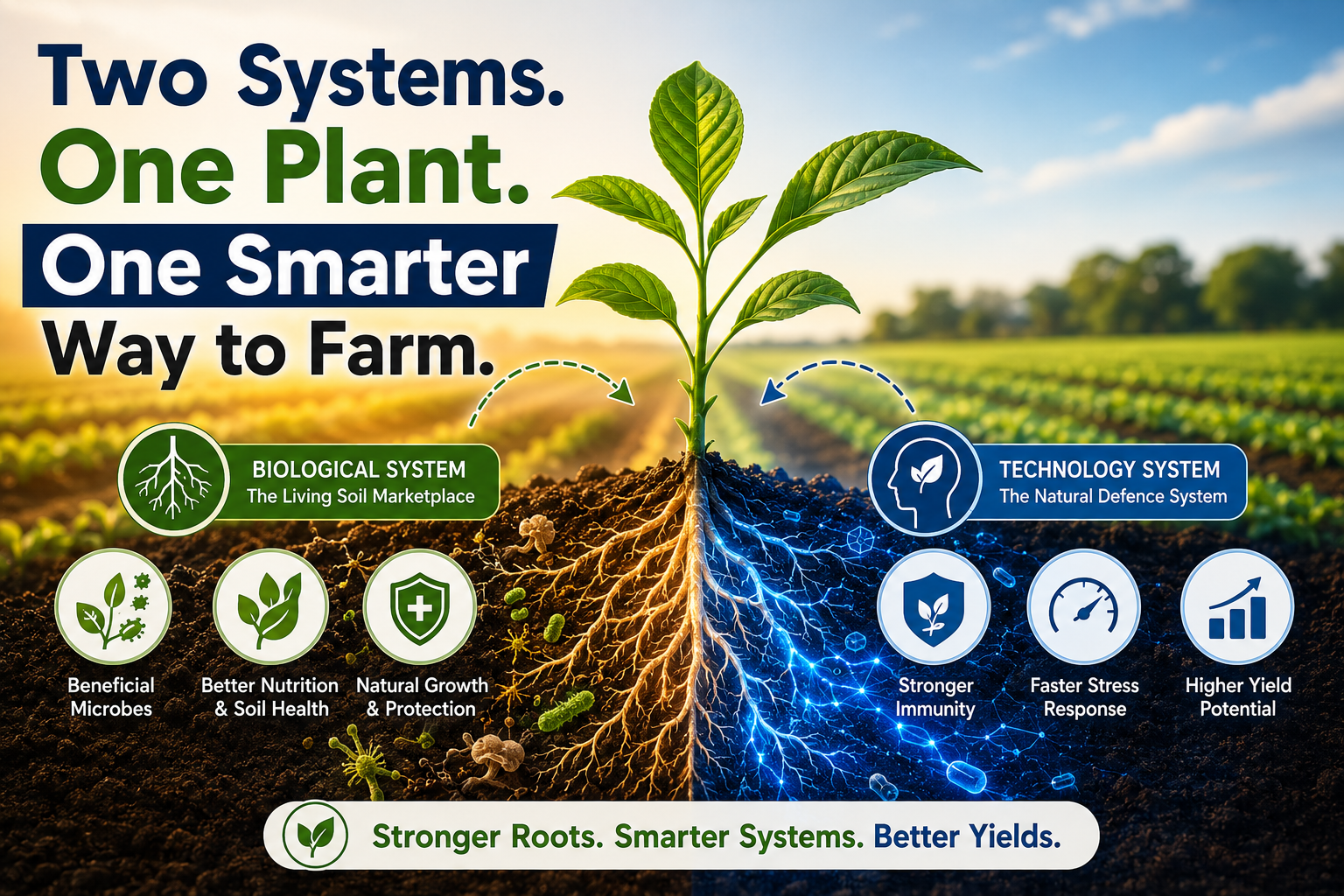
Understanding the Hidden Intelligence of Plants
Modern farming often treats plant nutrition, disease, and stress as separate problems. But plant science shows that everything inside a plant is deeply connected. For BioPrime, this understanding is helping shape a smarter and more resilient approach to agriculture.
In earlier parts of the Plant Biology Series, we explored two powerful ideas. First, the rhizosphere, the soil zone surrounding plant roots, functions like a living biological marketplace where plants exchange carbon with microbes for nutrients and protection. Second, plants can build a form of stress memory, allowing them to respond faster to future stress conditions.
The Connection Between Soil Microbiome and Plant Stress
The soil microbiome recruitment and plant stress memory are not separate systems. They continuously influence each other. Beneficial microbes around roots can activate the plant’s natural immune responses while also helping the plant build long-term resilience against future stress in plant systems.
Research shows that plants supported by beneficial microbes can maintain stronger defence responses even weeks after the original microbial interaction. This is why rhizosphere management is becoming increasingly important in modern agriculture.
How Abiotic Stress Alters the Soil Microbiome and Plant Recruitment Tactics
|
Feature |
Normal Condition (Baseline State) |
Abiotic Stress Condition (Emergency State) |
Functional Outcome Under Stress |
|
Plant Strategy |
Focus on growth, biomass accumulation, microbial diversity, and long-term soil ecosystem building |
Focus shifts toward immediate survival, cellular protection, and stress mitigation |
Conserves energy and prioritizes defensive physiology over growth |
|
Carbon Investment into Rhizosphere |
Broad carbon allocation into the rhizosphere (typically 20–40% of photosynthetically fixed carbon) |
Total carbon exudation may decrease, but targeted secretion increases around stressed root zones |
Enables selective recruitment of beneficial stress-adapted microbes |
|
Root Exudate Composition |
Dominated by primary metabolites such as simple sugars, amino acids, and organic acids |
Shift toward secondary metabolites including osmoprotectants, phenolics, flavonoids, ABA-associated compounds, and specialized organic acids |
Enhances stress signaling, antioxidant protection, and microbial selection |
|
Rhizosphere Microbial Diversity |
High microbial diversity with broad coexistence of bacteria, fungi, and decomposers |
Reduced overall diversity; enrichment of highly specialized stress-resilient taxa |
Creates a more functionally adapted microbiome under stress |
|
Core Microbial Partners |
Nutrient cyclers, decomposers, PGPR, and mycorrhizal fungi dominate |
Stress-tolerant microbes such as Bacillus, Pseudomonas, Actinobacteria, Trichoderma, and endophytes become dominant |
Improves osmoprotection, ISR activation, nutrient scavenging, and ROS detoxification |
|
Microbial Recruitment Signals |
General nutrient-sharing and symbiotic signaling |
Strong release of stress-associated signaling molecules such as strigolactones, flavonoids, and stress hormones |
Functions as a “cry for help” mechanism to attract protective microbes |
|
Rhizosphere Physical State |
Soil structure remains relatively loose with standard aggregation and moisture dynamics |
Formation of sticky biofilm-rich microzones with extracellular polysaccharides (EPS) and microbial slime |
Improves water retention, root adhesion, and microbial protection under drought or salinity |
|
Dominant Microbial Functions |
Nutrient mineralization, organic matter decomposition, and routine nutrient cycling |
Osmolyte production, antioxidant activity, ACC deaminase activity, siderophore production, and pathogen suppression |
Enhances plant stress tolerance and survival probability |
|
Plant–Microbe Communication |
Stable low-intensity signaling between roots and microbiome |
Intensified chemical signaling and rapid exchange of defense/stress metabolites |
Accelerates establishment of protective plant–microbe interactions |
|
Root Architecture Response |
Normal root elongation and branching patterns |
Altered root architecture with localized lateral root proliferation near beneficial microbial zones |
Maximizes nutrient and water acquisition efficiency under stress |
Why Early Intervention Matters
Traditional farming practices often react only after visible symptoms appear — yellow leaves, wilting, or poor growth. But by then, the plant has already lost energy and yield potential.
BioPrime focuses on biological interventions before visible damage begins. Supporting plants during early stress signalling stages helps maintain photosynthesis, energy production, and growth performance.
Early-season biological support can provide:
● Better nutrient absorption
● Stronger root systems
● Faster defence responses
● Improved stress tolerance
● Better yield protection throughout the season
This is the foundation of effective crop stress management, protecting the plant before stress becomes damaging.
What Disrupts These Natural Systems?
Several modern agricultural practices can weaken both rhizosphere biology and plant stress memory:
1. Excessive Use of Soluble Fertilizers
The Disruption Mechanism High levels of soluble nitrogen and phosphorus reduce the plant’s dependence on microbial nutrient exchange.
The Biological Toll Plants suppress root exudates like strigolactones, weakening AM fungi and rhizobia associations.
The Long-Term Insight Microbial populations decline, root systems shrink, and plants become increasingly dependent on chemical inputs.
2. Heavy Tillage and Soil Compaction
The Disruption Mechanism Tillage breaks fungal hyphal networks, while compaction reduces oxygen and pore space in soil.
The Biological Toll Beneficial aerobic microbes decline, fungal nutrient pipelines collapse, and anaerobic pathogens increase.
The Long-Term Insight Loss of soil aggregation and rhizosheath formation reduces water retention, root resilience, and soil stability.
3. Repeated Monocropping
The Disruption Mechanism Continuous cultivation of the same crop repeatedly selects the same microbial groups while suppressing diversity.
The Biological Toll Soil-borne pathogens accumulate and beneficial multifunctional microbes decline.
The Long-Term Insight Reduced microbial diversity weakens ecosystem resilience and limits stress-adaptive microbial recruitment.
4. Overuse of Broad-Spectrum Chemicals
The Disruption Mechanism Fungicides, herbicides, and pesticides disrupt essential microbial metabolic pathways in soil.
The Biological Toll Beneficial fungi and bacteria are unintentionally eliminated, disrupting rhizosphere balance.
The Long-Term Insight Loss of native microbiomes creates biological vacuums often recolonized by opportunistic pathogens.
5. Long Periods of Unmanaged Stress
The Disruption Mechanism Chronic stress exhausts plant energy reserves and disrupts normal stress signaling.
The Biological Toll Photosynthesis declines, carbon allocation to roots stops, and microbial recruitment signals disappear.
The Long-Term Insight Stress memory collapses, rhizosphere function deteriorates, and plants become highly vulnerable to further stress.
BioPrime’s Biological Approach
For BioPrime, the future of agriculture is not just about adding inputs. It is about understanding plant biology and supporting it at the right time.
The future of farming lies in stronger roots, healthier soil biology, and smarter crop stress management strategies. Because resilience is not applied at the last moment. It is built from the ground up, in the rhizosphere, in plant memory, and in every biological interaction happening beneath the soil.