
THE ₹50,000 CRORE PROBLEM BENEATH EVERY INDIAN FARM
- BioPrime Stories & latest news

- THE ₹50,000 CRORE PROBLEM BENEATH EVERY INDIAN FARM
THE ₹50,000 CRORE PROBLEM BENEATH EVERY INDIAN FARM

Why phosphorus isn't missing from our soils — it's trapped in them
Walk into any Indian field this sowing season and you'll find farmers doing exactly what they've always done: applying DAP, applying SSP, applying more phosphorus than the season before. And yet, crop after crop, the yield response keeps falling short of what the bag promised.
Here's the uncomfortable truth: the problem was never phosphorus deficiency. It's phosphorus availability.
India applies enormous quantities of phosphatic fertilizer every year, and consumes roughly 12% of the world's phosphate fertilizer supply. But of everything applied to a field, only 15–30% is actually taken up by the first crop. The remaining 70–85% gets locked away in the soil — chemically bound, biologically inert, agronomically useless — within weeks of application.
That is not a rounding error. That is the single largest inefficiency in Indian crop nutrition, and it sits quietly beneath almost every farm in the country.
Mapping the Deficiency
This isn't confined to a few districts. Soil testing data across the country shows that 83% of tested Indian soil samples are phosphorus-deficient — 17% critically so, 31% low, and 35% at only medium availability. Fewer than one in five samples tested sufficient.
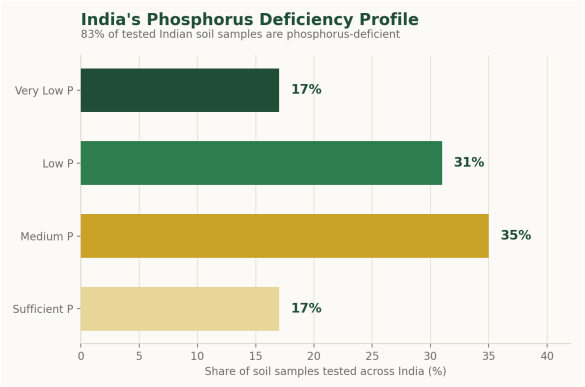
Figure 1: India's phosphorus deficiency profile across tested soil samples.
That's the map, in numbers: the vast majority of Indian farmland is running a phosphorus shortfall — not because the nutrient isn't there, but because of what happens to it the moment it enters the soil.
The Cost of a Nutrient We Already Own
This isn't an abstract soil-science footnote — it's a live economic crisis playing out in real time:
-
DAP imports now meet 67% of India's phosphate demand, up from 56% just a year earlier, as domestic DAP production has declined even while consumption holds steady.
-
The Indian government committed ₹37,216 crore in phosphatic and potassic (P&K) fertilizer subsidies for the Kharif 2025 season alone — roughly ₹13,000 crore more than the season before it.
-
Landed DAP costs India well over ₹55,000 per tonne on the international market, while the fertilizer is capped at roughly ₹27,000 per tonne for farmers — with the government absorbing the gap.
-
India's DAP supply chain has repeatedly been shaken by external shocks — from sudden drops in Chinese export volumes to global price spikes — because the country simply does not have enough phosphate rock reserves to be self-sufficient.
Every rupee spent importing phosphorus is a rupee spent on a nutrient that, in most cases, is already sitting in the soil — just not in a form the plant can use. We are paying, again and again, for phosphorus we already own.
Why Phosphorus Gets Locked in the First Place
Phosphorus is one of the most chemically reactive nutrients in soil. The moment it's applied — as fertilizer or released from organic matter — it starts reacting with metal ions and forming insoluble complexes:
| Soil condition | Phosphorus binds with | Resulting form |
|---|---|---|
| Acidic, high-Fe/Al soils | Iron & Aluminum | Fe-P, Al-P |
| Alkaline, calcareous soils | Calcium | Ca-P |
Both are effectively invisible to plant roots. And here's the part most fertilizer strategies miss entirely: 53% of Indian agricultural soils are dominated by iron- and aluminum-bound phosphorus, while only 12% are calcium-bound.
Yet almost every commercial Phosphate Solubilizing Bacteria (PSB) product on the market is screened and validated against Tricalcium Phosphate (TCP) — the calcium-bound form. Government registration itself only requires ~30 ppm of TCP solubilization. That means the industry standard is built to solve for the smaller problem, while the dominant form of locked phosphorus in Indian soils — Fe-P and Al-P — goes almost entirely unaddressed.
The biggest phosphorus pool in Indian soil remains untouched by most solutions available today.
How India Compares to the World
Phosphorus fixation isn't unique to India — globally, an estimated 40% of the world's soils restrict phosphorus availability through fixation, and acidic, Fe/Al-rich soils make up roughly 26% of the world's arable land. But India's problem is skewed harder toward the difficult end of that spectrum:
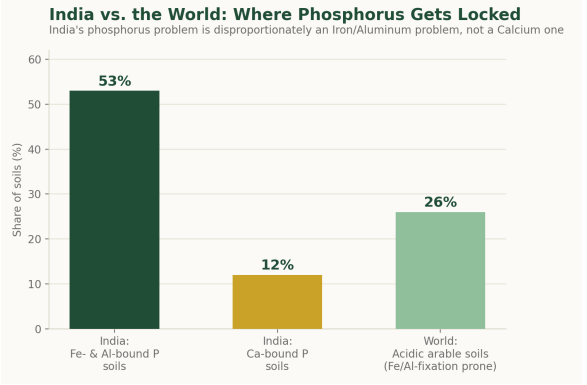
Figure 2: India's Fe/Al-bound phosphorus soils vs. Ca-bound soils, compared with the global share of acidic arable land.
At 53% Fe/Al-dominance, Indian soils carry roughly double the global share of acidic, fixation-prone arable land. This isn't a peripheral issue for a handful of regions — it's the defining chemistry of the Indian subcontinent's phosphorus problem, and one the global PSB industry, built largely around calcium-phosphate chemistry, was never designed to solve.
The pH Problem Underneath It All
Fe-P and Al-P fixation isn't random — it's driven directly by soil pH. As soils turn acidic, iron and aluminum become more chemically reactive and bind phosphorus almost as fast as it's applied. And India has a lot of acidic soil:
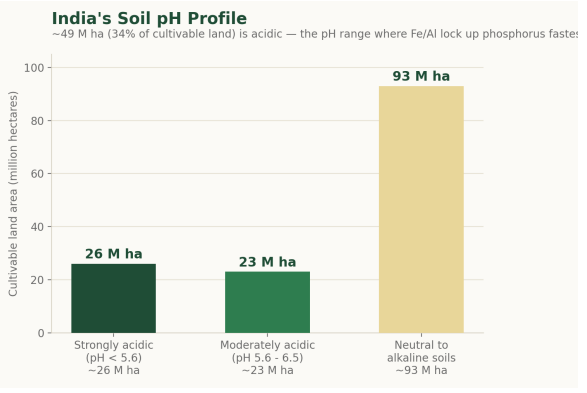
Figure 3: India's soil pH / acidity profile across cultivable land.
Roughly 49 million hectares — about 34% of India's cultivable land — is acidic, split between ~26 million hectares that are strongly acidic (pH below 5.6) and ~23 million hectares that are moderately acidic (pH 5.6–6.5). The northeastern states carry the sharpest edge of this problem, with acidity present across nearly the entire region and close to two-thirds of that land falling below pH 5.5. This is exactly the pH band where iron and aluminum oxides are most active — and where conventional, calcium-adapted PSBs are least effective.
Nutrient Use Efficiency: The Metric That Exposes the Gap
Nutrient Use Efficiency (NUE) is the clearest lens on this problem. When 70–85% of applied phosphorus is fixed rather than absorbed, NUE for phosphorus in Indian cropping systems remains among the lowest of any major nutrient — far below nitrogen and potassium efficiency benchmarks. Low NUE doesn't just mean wasted fertilizer spend; it means:
-
Farmers over-apply season after season, chasing yield that a locked nutrient can't deliver
-
Residual phosphorus accumulates in soil, altering microbial balance and long-term fertility
-
The subsidy burden compounds nationally, even as on-farm outcomes stagnate
Improving phosphorus availability — not phosphorus quantity — is the single highest-leverage move available to Indian agriculture right now.
A Gap That's Been Widening for Decades
This isn't a new problem — it's a compounding one. Since 1971–72, India's phosphatic (P2O5) fertilizer consumption has grown roughly 14x, while foodgrain production over the same period has grown only about 3x.
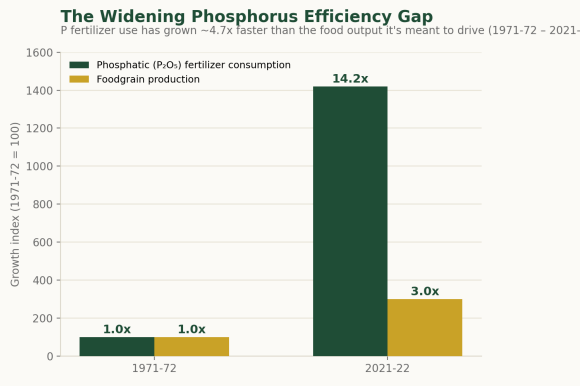
Figure 4: Growth in phosphatic fertilizer consumption vs. foodgrain production, indexed to 1971–72.
Independent research tracking India's cropland nutrient budgets from 1970 to 2010 found phosphorus use efficiency declining steadily over that period before flattening out at roughly 40% — a level high-income countries had already moved past by the 1970s. A more recent whole-system analysis of Indian phosphorus flows puts on-farm P efficiency even lower, at around 32%, versus a global average closer to 46%. Put simply: India has spent fifty years applying more and more phosphorus to close a gap that fixation, not scarcity, keeps reopening.
Where Conventional Biology Falls Short
Phosphate Solubilizing Bacteria have long been positioned as the biological answer: naturally occurring microorganisms that release organic acids and enzymes to convert fixed phosphorus into plant-available forms. The concept is sound. The execution, industry-wide, has been incomplete.
Conventional PSBs are typically:
-
Screened only against simple calcium phosphate (TCP)
-
Weak or entirely inactive against Fe-P and Al-P
-
Prone to performance collapse under buffered, real-world soil conditions
-
Inconsistent across India's diverse pH and temperature ranges
Which means the products farmers are already buying to solve this problem are, for the majority of Indian soil types, solving for a phosphorus pool that isn't the main one locking up their fertilizer investment.
BioPrime's Approach: Phosphonexus
This is precisely the gap Phosphonexus was engineered to close.
Built on BioNexus — one of India's largest plant-associated microbiome libraries, with 18,000+ microbial strains — Bio Prime's discovery platform ran high-throughput functional screening across 140+ phosphate-mobilizing candidates, evaluated against 34 functional traits including TCP solubilization, buffered-condition performance, Fe-P mobilization, Al-P mobilization, pH stability, and temperature stability.
The result is a proprietary, high-performance strain engineered specifically for field variability — not just laboratory conditions.
What that looks like in measured performance:
| Phosphorus form | Difficulty | Competitor PSB | Phosphonexus |
| Calcium Phosphate (TCP) | Easy | 30–57 ppm | 98–120 ppm |
| Buffered TCP (real soil simulation) | Moderate | No activity | Active under buffered conditions |
| Rock Phosphate | Moderate–Difficult | No activity | Up to 43 ppm |
| Iron-bound (Fe-P) | Difficult | No activity | Up to 30 ppm |
| Aluminum-bound (Al-P) | Very difficult | No activity | Up to 43 ppm |
In practical terms: where standard PSBs solubilize 30–60 ppm of phosphorus and stop, Phosphonexus performs at 80–120 ppm — up to 4x higher solubilization potential — and remains stable across a pH range of 4.5–9.5 and a temperature range of 10–50°C. It is the only approach in this comparison that mobilizes calcium-, iron-, and aluminum-bound phosphorus in a single formulation.
What This Means in the Field
In trial data, the treatment (P5) improved native soil phosphorus solubilization by approximately 50% compared to untreated control — alongside higher plant height, greater biomass, stronger root development, higher phosphorus uptake, and improved recovery efficiency.
That's not marginal. That's the difference between a fertilizer program that fights the soil and one that works with it.
Making Existing Phosphorus Work Harder
The story of phosphorus in Indian agriculture has never really been about scarcity. It's about access. The nutrient is there — in the soil, and in every bag of DAP or SSP applied over the last decade — sitting locked away in forms that neither roots nor most biological products can reach.
Solving that isn't just an agronomic win. It's a chance to ease a national import bill, reduce the subsidy burden taxpayers carry every season, and hand farmers back the value of an input they've already paid for.
At Bio Prime, we're not formulating another product to add to the input stack. We're engineering biological responses that unlock what's already there — accessing the phosphorus others can't reach, so farmers can build confidence in their crops, resilience in their soils, and prosperity for the seasons ahead.