
Stress Memory in Plants: How Resilience is encoded in plants?
- BioPrime Stories & latest news

- Stress Memory in Plants: How Resilience is encoded in plants?
Stress Memory in Plants: How Resilience is encoded in plants?
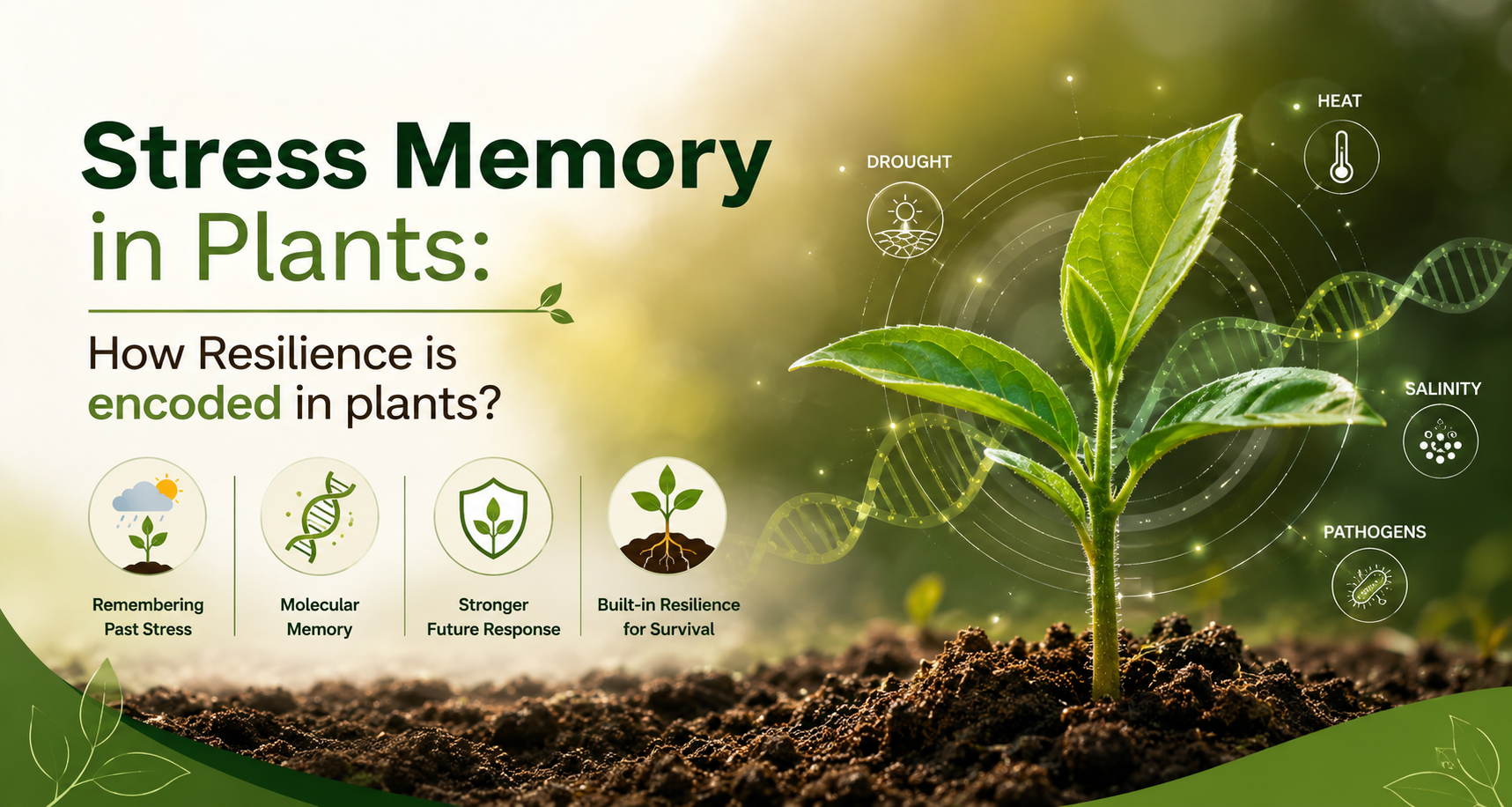
Plants may not have brains, but science shows they can remember stress. Through advanced biological mechanisms, plants store information from past stress events and respond more efficiently when stress returns. This process, known as stress memory or priming, is changing how we think about farming, crop resilience, and sustainable agriculture.
At BioPrime, this understanding is central to building smarter and more resilient crop systems through biological solutions and sustainable plant health management.Infact Prime in Bioprime is derived from this stress “priming” phenomenon in the plant
What Is Stress Memory or Priming in Plants?
When a plant experiences drought, heat, pathogens, or nutrient stress, its internal systems adapt. The next time the same stress appears, the plant reacts faster and more effectively. This is not a genetic mutation. Instead, it is a temporary molecular reprogramming that improves the plant’s response system.
One important process behind this is called priming. A mild stress event acts like a rehearsal for the plant. Defense systems are partially prepared in advance, allowing the plant to react quickly when serious stress occurs later.Lets look at how this happens across different conditions, the specific biochemical signals involved, and the speed and duration of this molecular adaptation
Plant Stress Priming: Types, Molecular Mechanisms, and Memory Dynamics
1. Examples of Stress Priming in Plants
|
Stress Type |
Priming Trigger |
Primed Response |
Functional Advantage |
|
Drought Priming |
Mild early-season water deficit |
Faster stomatal closure, rapid osmolyte accumulation, improved photosynthetic stability during later drought |
Enhances water-use efficiency and drought survival |
|
Heat Priming (Thermotolerance) |
Short exposure to non-lethal high temperature (e.g., ~38°C for a few hours) |
Rapid synthesis of Heat Shock Proteins (HSPs) during subsequent heat stress |
Prevents protein aggregation and protects cellular structures during heatwaves |
|
Pathogen Priming (Systemic Acquired Resistance – SAR) |
Localized pathogen infection |
Activation of systemic defense pathways and rapid antimicrobial protein production in distant tissues |
Provides broad-spectrum resistance against future pathogen spread |
|
Cold Priming (Chilling Hardening) |
Exposure to low but non-freezing temperatures |
Stabilization of membrane fluidity and reduced ice-crystal injury during freezing events |
Improves cold tolerance and freeze survival |
2. Molecular Basis of Plant Stress Memory
|
Molecular Component |
Primary Role |
Mechanism in Priming and Memory |
|
Abscisic Acid (ABA) |
Drought and salinity memory |
Regulates stomatal closure, osmotic adjustment, and stress-responsive gene activation |
|
Salicylic Acid (SA) |
Defense against viral and bacterial pathogens |
Coordinates systemic acquired resistance (SAR) and immune signaling |
|
Jasmonic Acid (JA) |
Defense against insects and necrotrophic pathogens |
Activates wound and herbivory defense pathways |
|
Mitogen-Activated Protein Kinases (MPK3/MPK6) |
Rapid stress-response amplification |
Stored in inactive form and rapidly activated upon secondary stress exposure |
|
Reactive Oxygen Species (ROS) |
Early systemic alarm signaling |
Controlled H₂O₂ bursts maintain antioxidant systems in a “ready state” |
|
Epigenetic Histone Marks (e.g., H3K4me3) |
Long-term stress memory encoding |
Keep defense genes in an open and transcriptionally accessible state |
|
Removal of Repressive Marks (e.g., H3K27me3) |
Sustained defense readiness |
Prevents silencing of stress-responsive genes for extended periods |
3. Timeline of Priming Response and Memory Persistence
|
Time Scale |
Biological Event |
Key Molecular Changes |
|
Minutes to Hours |
Initial stress perception and signaling |
ROS bursts, ABA/SA accumulation, activation of signaling cascades |
|
Hours to Days |
Establishment of the primed state |
Histone modifications, accumulation of dormant MPK proteins, gene accessibility changes |
|
Days to Weeks |
Short-term somatic memory |
Temporary maintenance of epigenetic marks in vegetative tissues |
|
Months |
Long-term developmental memory |
Stable epigenetic regulation such as vernalization-associated flowering memory |
|
Generations |
Transgenerational stress memory |
Transmission of stress-associated epigenetic marks through seeds |
4. Duration and Persistence of Plant Stress Memory
|
Memory Type |
Typical Duration |
Biological Significance |
|
Short-Term Somatic Memory |
~5–14 days |
Allows plants to respond more efficiently to recurring stress events within the same season |
|
Long-Term Somatic Memory |
Weeks to months |
Supports seasonal developmental adaptations such as flowering regulation |
|
Transgenerational Memory |
1–3 generations |
Provides offspring with preconditioned stress tolerance before germination |
Beneficial microorganisms such as Bacillus, Pseudomonas, and Trichoderma can trigger Induced Systemic Resistance (ISR) in plants. Through the release of microbial signals and metabolites, these organisms activate the plant’s immune signaling pathways without causing disease. As a result, the plant enters a “primed” defensive state, enabling faster and stronger responses against subsequent pathogen or insect attacks.The result is a plant that is biologically prepared for future attacks from fungi, bacteria, viruses, or insects. This broad-spectrum readiness is one of the strongest advantages of biological crop protection.
How Plants Store Stress Information
Plants also use epigenetic memory to store stress experiences. Through changes in DNA packaging and gene accessibility, plants can keep stress-response genes ready for future activation. In some cases, this memory can even pass to the next generation through seeds.
Why This Matters for Agriculture
Understanding plant stress memory has major implications for modern farming. Early-season biological applications, healthy root systems, and Rhizosphere-focused solutions can improve resilience throughout the crop cycle.
For farmers, this means:
● Better tolerance to drought and environmental stress
● Faster disease response
● Reduced yield loss
● Stronger long-term crop performance
As agriculture moves toward sustainable plant health management, companies like BioPrime, are helping farmers work with plant biology instead of against it, building crops that are naturally stronger, healthier, and more prepared for the future.