
WHAT HAPPENS INSIDE A PLANT DURING THE FIRST HOUR OF STRESS?
- BioPrime Stories & latest news

- WHAT HAPPENS INSIDE A PLANT DURING THE FIRST HOUR OF STRESS?
WHAT HAPPENS INSIDE A PLANT DURING THE FIRST HOUR OF STRESS?
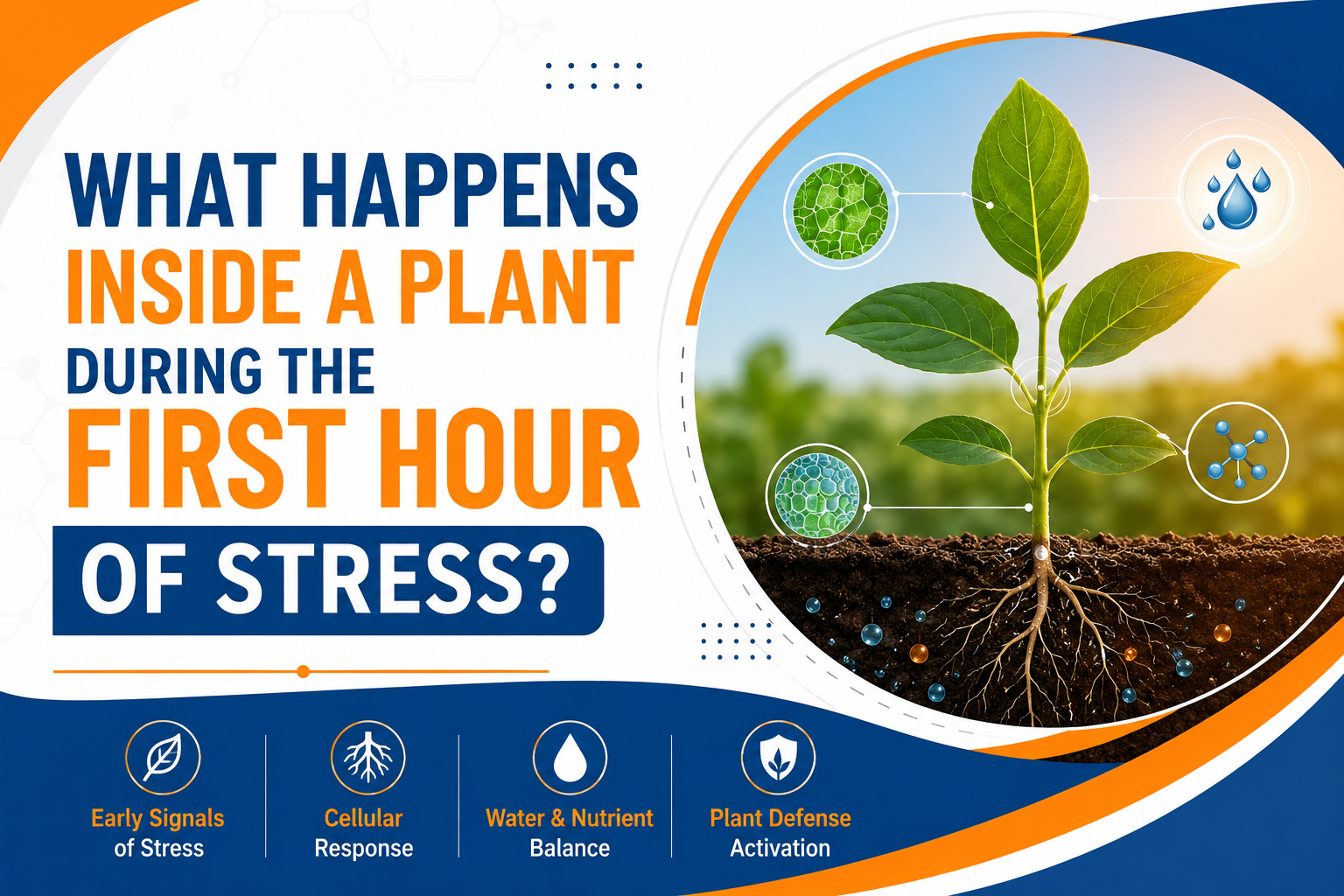
A minute-by-minute account of a response farmers won't see for three more days
A field looks completely unremarkable the day a heatwave hits, or the afternoon a root first encounters dry soil. No wilting. No discoloration. Nothing a walk-through would catch. And yet, inside every plant in that field, one of the fastest coordinated biological responses in nature is already underway — a cascade that begins within seconds of the stressor arriving and doesn't finish for days.
By the time a farmer sees a symptom, the plant has already run through roughly seven distinct physiological stages. This is a walk through what actually happens, minute by minute, hour by hour — grounded in the plant signaling literature, not metaphor.
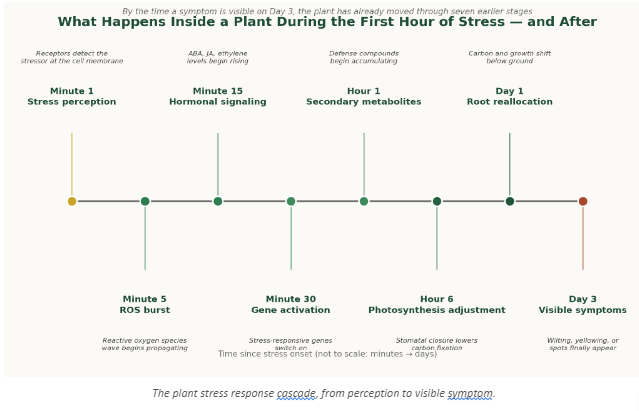
Minute 1: Stress Perception
The moment a stressor arrives — a pathogen's molecular signature, a mechanical wound, a sudden spike in leaf temperature, a shift in osmotic pressure at the root — it is detected at the cell membrane by dedicated receptor systems: pattern-recognition receptors for pathogens, mechanosensitive ion channels for physical damage, and osmotic sensors for water stress. This isn't a slow chemical drift. It's closer to a switch being thrown.
Membrane-localized receptors trigger an almost immediate influx of calcium ions into the cell — the first universal currency of stress signaling across the plant kingdom, and the trigger for everything that follows.
Minute 5: The ROS Burst
Within minutes, cells at the stress site begin producing reactive oxygen species (ROS) — primarily hydrogen peroxide — via an enzyme called RBOHD (a plant NADPH oxidase). This isn't incidental oxidative damage. It's a deliberate, self-propagating signal known as the ROS wave, first characterized by Ron Mittler's lab. Depending on the stress and tissue type, this wave has been measured propagating at rates from roughly 400 to 1,400 micrometers per second — fast enough that in a landmark study, a stress-responsive gene reporter (ZAT12) showed a detectable transcriptional response just 20 seconds after local stimulation.
Averaged across whole-plant propagation, this systemic ROS signal moves at roughly 8.4 centimeters per minute — which sounds modest until you consider it's outrunning simple chemical diffusion by a wide margin, precisely because it's an active, cell-to-cell relay rather than a passive drift of molecules.
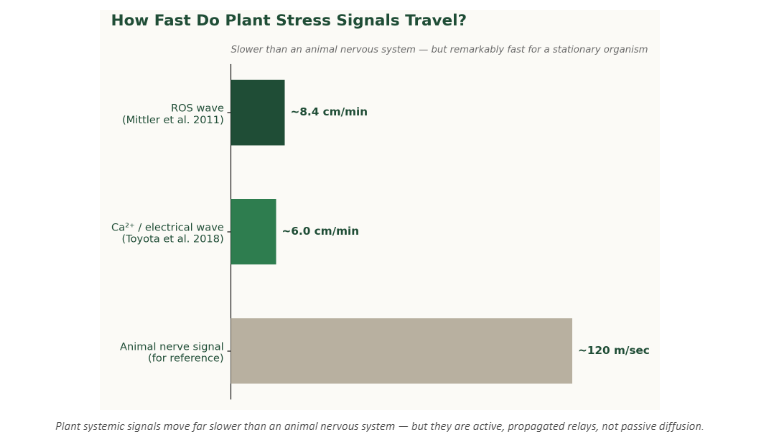
Running in parallel with the ROS wave is a calcium and electrical signal. In a landmark 2018 study, Toyota and colleagues showed that wounding causes glutamate to leak from damaged cells, which is sensed by glutamate receptor-like (GLR) channels and triggers a wave of calcium ions that visibly propagates across the entire plant — leaf to leaf — at speeds around 1 millimeter per second, reaching distant tissue within about two minutes of the original injury.
Minute 15: Hormonal Signaling
As the ROS and calcium waves reach systemic tissue, they trigger a shift in the plant's hormonal balance. Abscisic acid (ABA) begins accumulating in response to water-deficit and osmotic signals; jasmonic acid (JA) rises in response to wounding and herbivory; ethylene and salicylic acid shift in response to pathogen cues. These hormones don't act in isolation — they cross-talk constantly, sometimes reinforcing each other and sometimes actively suppressing one another depending on which stress is dominant.
The jasmonate pathway illustrates just how fast this can move from signal to action: under normal conditions, JAZ repressor proteins keep defense genes switched off by blocking the transcription factor MYC2. The moment JA accumulates, it triggers rapid degradation of those JAZ repressors via the proteasome — releasing MYC2 to activate defense transcription almost immediately. It's a molecular switch, not a slow dial.
Minute 30: Gene Activation
Hormonal signals converge on the nucleus, where transcription factors begin switching on stress-responsive genes. This happens faster than most people assume: in high-light stress experiments, just 2 minutes of exposure was enough to induce the first wave of recovery-linked genes, and by 15 minutes, a broader set of oxidative and photoprotective genes were already measurably switched on.
This is the stage where the plant genome itself starts to reorganize its priorities — down-regulating genes tied to normal growth and up-regulating genes tied to defense, osmotic adjustment, or antioxidant production, depending on the nature of the stress detected.
Hour 1: Secondary Metabolite Production
With defense genes active, the plant begins manufacturing the actual molecular tools of its response: terpenoids, flavonoids, phenolics, and alkaloids — compounds that were explored in depth elsewhere in this series as biological “messages” in their own right. This is also where the concept of priming becomes critical. Decades of research, most notably synthesized by Uwe Conrath and colleagues, has shown that plants which have previously encountered a stressor — or been exposed to a priming agent — mount these defense responses faster and more strongly the second time, without paying the metabolic cost of running the defense constantly. It's less like a fixed reaction and more like an immune memory.
Hour 6: Photosynthesis Adjustment
By several hours in, the stress response starts visibly reshaping the plant's energy economy. ABA accumulation activates the PYL-PP2C-SnRK2 signaling module in guard cells, triggering stomatal closure to conserve water — but closing stomata also restricts CO₂ entry, which throttles photosynthesis as a direct side effect of the plant's own defensive choice. This is a genuine trade-off, not a malfunction: the plant is deliberately sacrificing carbon gain for water conservation, a bet that only pays off if the stress is real and ongoing.
Day 1: Root Reallocation
Within a day, the stress response reaches all the way down to resource allocation strategy. Carbon and growth investment measurably shift away from shoot expansion and toward root development — particularly under drought or nutrient limitation, where a plant's best chance of resolving the stress is physically reaching new soil volume rather than growing more leaf area it can no longer adequately support.
Day 3: Visible Symptoms
Only now — roughly three days after the original stress event, in many drought and nutrient-stress scenarios — does a human observer walking the field see anything at all: wilting, a shift toward yellowing or reddening (often anthocyanin accumulation, itself a late-stage stress marker), leaf curling, or slowed growth. The symptom is not the stress starting. It's the stress finishing its opening act.
Farmers see symptoms. The plant started responding days earlier.
Why This Timeline Changes How We Think About Intervention
Every stage in this cascade before Day 3 is, in principle, detectable — through metabolite profiling, hormone assays, or gene expression markers — well before a human eye could catch anything. That's the practical significance of this science: the conventional model of crop management, built around responding to visible symptoms, is by definition intervening at the very last stage of a multi-day biological process, after the plant has already paid most of the metabolic cost of its own defense.
It's also why priming matters as a strategy, not just a research curiosity. A plant primed in advance — through prior exposure, a beneficial microbial partner, or a priming-active biological input — doesn't skip this cascade. It runs the same seven stages, but faster and with less resource cost, because the molecular machinery for defense is already partially staged and waiting rather than being built from scratch after the stressor arrives.
This is the layer BioPrime's work in secondary metabolites and microbial signaling is built around: not overriding a plant's stress response after symptoms appear, but understanding — and where possible, supporting — the cascade that's already running in the first minutes and hours, long before a field walk would ever catch it.
References & Further Reading
-
Suzuki, N. & Mittler, R. (2014). ROS as key players in plant stress signalling. Journal of Experimental Botany, 65(5), 1229–1240. — https://academic.oup.com/jxb/article/65/5/1229/2884856
-
Choi, W.G., Miller, G., Wallace, I., Harper, J., Mittler, R. & Gilroy, S. (2017). Orchestrating rapid long-distance signaling in plants with Ca²⁺, ROS and electrical signals. The Plant Journal / PMC. — https://pmc.ncbi.nlm.nih.gov/articles/PMC5677518/
-
Fichman, Y. et al. (2023). ROS are evolutionary conserved cell-to-cell stress signals. PNAS, 120. — https://www.pnas.org/doi/10.1073/pnas.2305496120
-
Fichman, Y. & Mittler, R. (2020). Rapid systemic signaling during abiotic and biotic stresses: is the ROS wave master of all trades? The Plant Journal, 102(5), 887–896. — https://onlinelibrary.wiley.com/doi/full/10.1111/tpj.14685
-
Zandalinas, S.I. & Mittler, R. (2021). Vascular and nonvascular transmission of systemic reactive oxygen signals during wounding and heat stress. Plant Physiology, 186(3), 1721–1733. — https://academic.oup.com/plphys/article/186/3/1721/6211198
-
Toyota, M., Spencer, D., Sawai-Toyota, S., Jiaqi, W., Zhang, T., Koo, A.J., Howe, G.A. & Gilroy, S. (2018). Glutamate triggers long-distance, calcium-based plant defense signaling. Science, 361(6407), 1112–1115. — https://www.science.org/doi/10.1126/science.aat7744
-
University of Wisconsin–Madison (2018). Blazes of light reveal how plants signal danger long distances. [Summary of Toyota & Gilroy 2018] — https://news.wisc.edu/blazes-of-light-reveal-how-plants-signal-danger-long-distances/
-
Ha, S. et al. (2010). Molecular and physiological analysis of drought stress in Arabidopsis reveals early responses leading to acclimation in plant growth. Plant Physiology, 154(3), 1254–1271. — https://academic.oup.com/plphys/article/154/3/1254/6111291
-
Kim, T.H. et al. Signaling Transduction of ABA, ROS, and Ca²⁺ in Plant Stomatal Closure in Response to Drought. PMC. — https://pmc.ncbi.nlm.nih.gov/articles/PMC9736234/
-
Jasmonic acid signaling and glutathione coordinate plant recovery from high light stress. PMC. — https://www.ncbi.nlm.nih.gov/pmc/articles/PMC12038154/
-
Conrath, U., Beckers, G.J.M., Langenbach, C.J.G. & Jaskiewicz, M.R. (2015). Priming for Enhanced Defense. Annual Review of Phytopathology, 53, 97–119. — https://www.annualreviews.org/content/journals/10.1146/annurev-phyto-080614-120132
-
Conrath, U. et al., Prime-A-Plant Group (2006). Priming: Getting Ready for Battle. Molecular Plant-Microbe Interactions, 19, 1062–1071. — https://pubmed.ncbi.nlm.nih.gov/17022170/
Note: exact timings (ROS wave speed, gene induction onset, symptom appearance) vary by species, stress type, and severity; the figures above are representative values drawn from the cited primary literature, most of it generated in Arabidopsis and a small number of crop model systems, and should be treated as illustrative of general cascade timing rather than precise universal constants.