From Folklore to Plant Physiology: The Evolution of Biostimulants
- BioPrime Stories & latest news

- From Folklore to Plant Physiology: The Evolution of Biostimulants
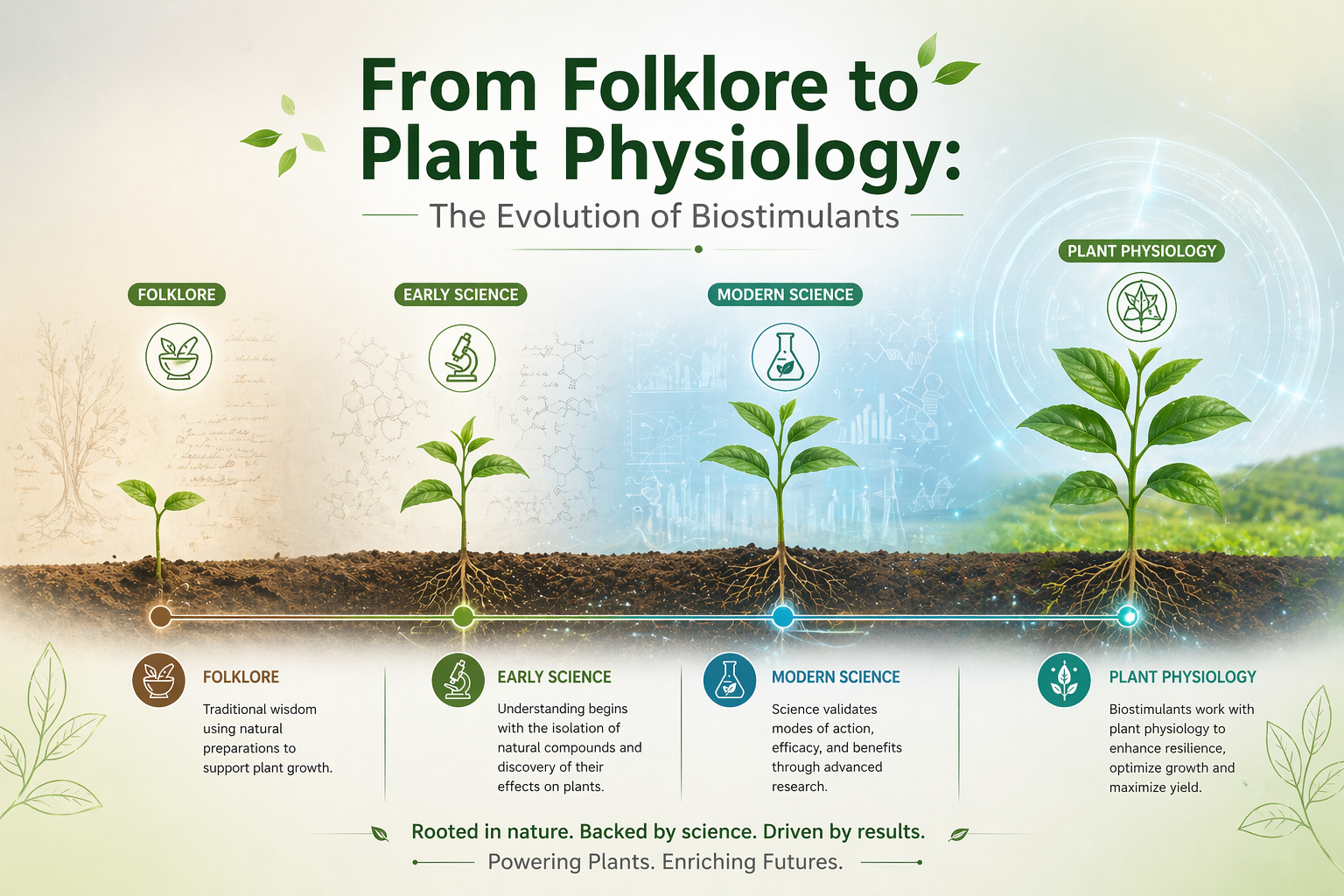
From Folklore to Plant Physiology: The Evolution of Biostimulants
A Journey That Started with Tradition
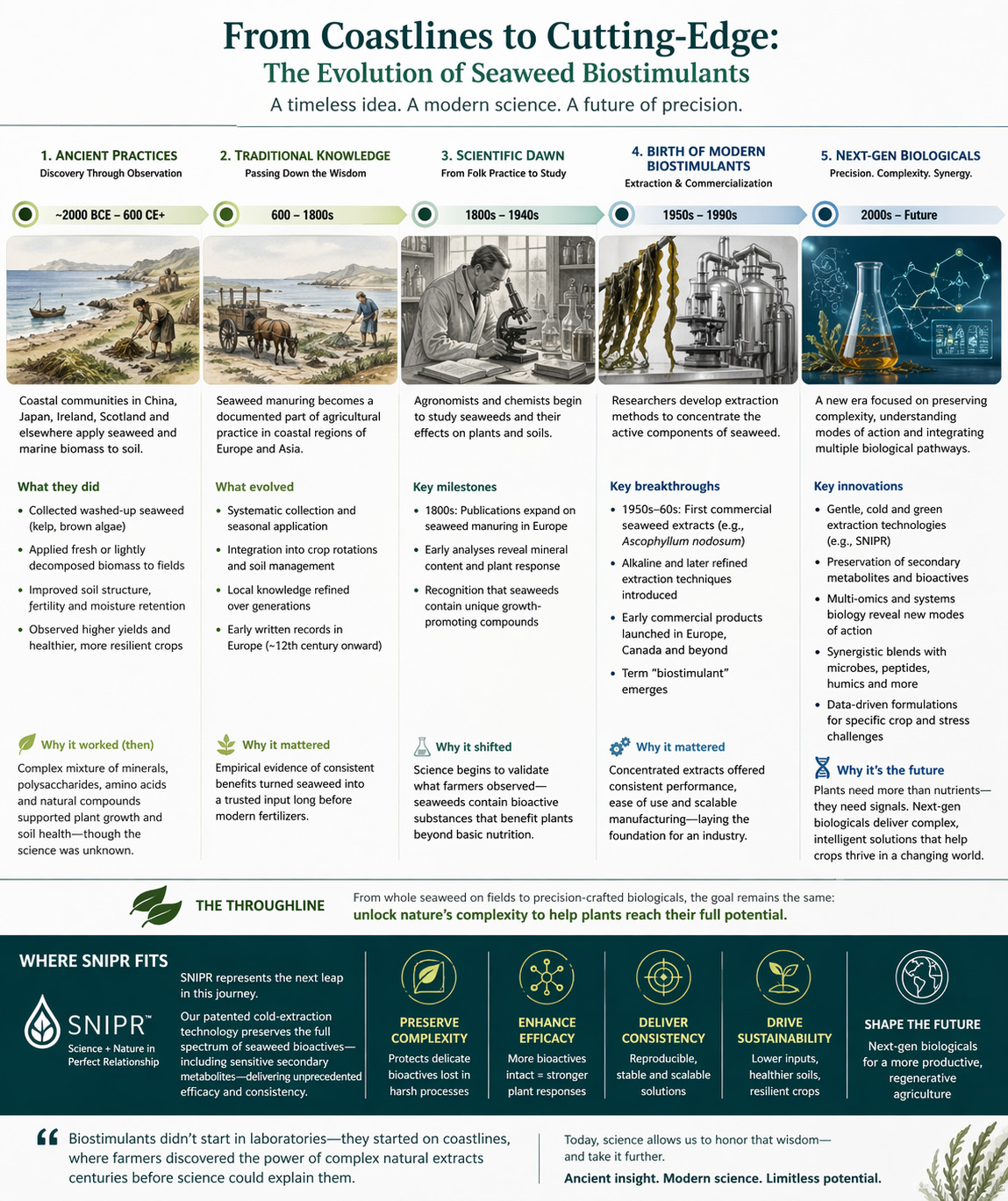
Biostimulants have long existed at the intersection of tradition and agriculture. The first recorded use of seaweed as a soil amendment goes back thousands of years-Ancient coastal farming communities in regions like China, Japan, and parts of Scotland and Ireland used fresh seaweed as manure.In Ireland and Scotland, this practice is documented as early as ~4th–6th century CE, though it likely predates written records.
“Biostimulants didn’t start in laboratories—they started on coastlines, where farmers discovered the power of complex natural extracts centuries before science could explain them.”
For thousands of years, their use was guided less by science and more by observation, farmers applying seaweed extracts, humic substances, and organic formulations based on visible improvements in crop health.
The shift from raw seaweed → scientific biostimulants happened much later in 1950s–1960s
- First seaweed extracts developed, particularly from brown algae like Ascophyllum nodosum
- Work led by researchers in Canada, UK, and Norway
- Extraction methods (alkaline, later cold extraction) enabled concentrated products
Companies began commercializing seaweed-based products—this is when “biostimulants” start resembling what we know today.
But today, the question is more fundamental:
Are we understanding how and why these inputs actually work?
This is where the category is undergoing a structural shift, from belief systems to scientific discipline.
The Scientific Shift: Rise of Plant Signaling
Advances in plant physiology have fundamentally changed how we look at biostimulants. The focus is no longer on what is applied, but on how the plant responds.
Plants are not passive recipients of nutrients. They are dynamic biological systems governed by internal signaling networks that regulate growth, stress tolerance, and nutrient uptake.
This has led to the emergence of plant signaling science, where inputs are designed to:
- Trigger specific biochemical pathways
- Enhance stress resilience mechanisms
- Optimise growth responses under varying conditions
This transition marks a critical phase of innovation in farming, moving from input-driven agriculture to response-driven agriculture.
Beyond Nutrition: The Role of Secondary Metabolites
Traditional agriculture has been built around macronutrients, nitrogen, phosphorus, and potassium. However, biostimulants operate through a different layer of plant biology.
Their primary drivers are secondary metabolites, bioactive compounds that:
- Regulate plant metabolism
- Influence hormonal balance
- Activate stress-response pathways
Unlike nutrients, these molecules do not “feed” the plant directly. They modulate how efficiently the plant uses what it already has.
This distinction is central: Nutrition supports growth. Biology directs it.
The Limitation: Why “Natural” Is Not Enough
The increasing demand for sustainable agriculture has amplified the appeal of “natural” solutions. However, natural does not automatically mean effective.
Key challenges persist:
- Variability in composition across sources
- Lack of standardisation in formulations
- Inconsistent field performance
In high-stakes agricultural systems, variability translates directly into risk. Farmers do not just need natural inputs, they need predictable outcomes.
This is where biotechnology farming becomes essential, bringing scientific rigour, reproducibility, and precision to nature-derived solutions.
The Inflection Point: From Observation to Decoding
The next phase of biostimulants is not about discovering new natural inputs.It is about decoding the ones we already use.
Understanding:
- Which molecules are active
- How they interact with plant systems
- Under what conditions they perform best
This is the difference between correlation and causation and it defines the future of the category.
The Bioprime Approach: Science-Led Biologicals
Bioprime is building at this exact intersection of biology and precision.
Through its SNIPR platform, the company focuses on:
- Identifying functional bioactive compounds
- Mapping their interaction with plant signaling pathways
- Designing targeted, consistent formulations
The objective is clear:
Convert nature into a predictable, high-performance input system.
This is not an extension of traditional biostimulants- it is a redefinition.
The Category is Evolving
The shift is already underway.
|
Then |
Now |
|---|---|
|
Tradition-driven use |
Science-led application |
|
Natural inputs |
Decoded bioactives |
|
Inconsistent outcomes |
Predictable performance |
|
Input focus |
Plant response focus |
Biostimulants are no longer an adjunct to agriculture. They are becoming a core scientific layer within it. The future will not be defined by what is natural but by what is understood, validated, and optimised. Bioprime is building for that future, where biology is not assumed, but engineered for performance.