
Bioprime’s Differentiation in NUE: Addressing the Real Challenge
- BioPrime Stories & latest news

- Bioprime’s Differentiation in NUE: Addressing the Real Challenge
Bioprime’s Differentiation in NUE: Addressing the Real Challenge

India’s agricultural conversation is changing. For decades, success was measured by how much we could produce. Today, the real issue is not yield, it is efficiency. More specifically, how effectively are we using fertilizers?
Globally, Nutrient Use Efficiency (NUE) remains below 30%. This means over 70% of applied fertilizers are wasted, lost to air, water, or locked in the soil. In India, this inefficiency is even more visible due to the widespread and often indiscriminate use of fertilizers, especially urea.
The Real Cost of Overuse
The overuse of fertilizers has created a silent crisis. Farmers are applying more inputs, but returns are not increasing at the same pace. Instead, they face rising costs and stagnating productivity.
At the same time, the environmental impact is growing:
● Soil degradation due to nutrient imbalance
● Loss of organic carbon and soil fertility
● Water pollution from nutrient runoff
● Increased greenhouse gas emissions
What once helped boost production is now weakening the foundation of agriculture itself.
Why Current Solutions Fall Short
Approaches like balanced fertilization, precision farming, and the 4R framework (right source, rate, time, and place) are important steps forward. They help reduce waste and improve targeting.
However, they do not fully solve the core issue, low nutrient absorption by plants. Even when fertilizers are applied correctly, plants often cannot utilize a large portion of those nutrients. This creates a ceiling for efficiency gains.
They improve how fertilizers are applied. But they do not fully address how nutrients are utilized within the plant-soil system
Bioprime’s Approach: Turning Biology into an Efficiency Engine
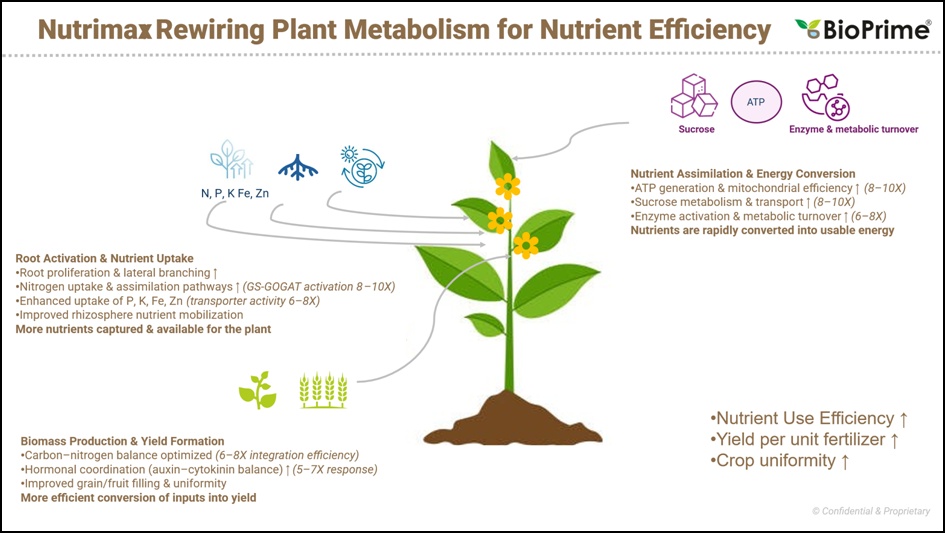
Bioprime approaches Nutrient Use Efficiency (NUE) as a three-stage biological challenge—availability, uptake, and utilization. In most systems, nutrients are either locked in the soil, insufficiently absorbed, or inefficiently converted into plant output. Nutrimax is designed to act across all three, ensuring that nutrients move seamlessly from soil → root → metabolism → yield.
What Changes Inside the Plant (Physiology Simplified)
1. Nutrient Availability (Soil–Root Interface)
· Activation of rhizosphere biology → better nutrient mobilization
· Solubilization of bound P, K, Fe, Zn
· Increased pool of plant-available nutrients
2. Nutrient Uptake (Root System Efficiency)
· Root proliferation & lateral branching ↑
· Root surface area & absorption zone ↑
· Activation of nutrient transporters for N, P, K, Fe, Zn
· Enhanced nitrogen assimilation via GS-GOGAT pathway
3. Nutrient Utilization (Metabolic Efficiency)
· ATP generation & mitochondrial efficiency ↑
· Sucrose metabolism & transport ↑ (better source–sink movement)
· Enzyme activation & metabolic turnover ↑
· Improved carbon–nitrogen balance
4. Yield Formation (End Outcome)
· Better conversion of nutrients → biomass
· Improved grain/fruit filling
· Higher crop uniformity
· Increased yield per unit fertilizer
At a systems level,Nutrimax ensures that nutrients are not just present—but available, absorbed, and efficiently converted into yield.
Integration, Not Replacement
Bioprime does not aim to replace fertilizers. Instead, it integrates seamlessly with existing fertilizer programs, making them more effective. This ensures farmers get better returns from the same investment while reducing environmental impact.
A Global Need, A Timely Opportunity for India
Around the world, agriculture is shifting toward efficiency-driven practices. Markets in Europe and North America are already adopting biological solutions to improve NUE. For India, this shift is even more critical. With rising input costs, soil health concerns, and climate pressure, improving efficiency is no longer optional.
Conclusion
The future of agriculture lies in doing more with less. Bioprime’s approach addresses the root of the problem, low NUE by turning biology into a powerful ally. Because the next agricultural revolution will not be driven by adding more inputs, but by making every input count.