
THE CARBON LEDGER: CAN INDIA'S DEGRADED SOILS BECOME AN EXPORT?
- BioPrime Stories & latest news

- THE CARBON LEDGER: CAN INDIA'S DEGRADED SOILS BECOME AN EXPORT?
THE CARBON LEDGER: CAN INDIA'S DEGRADED SOILS BECOME AN EXPORT?
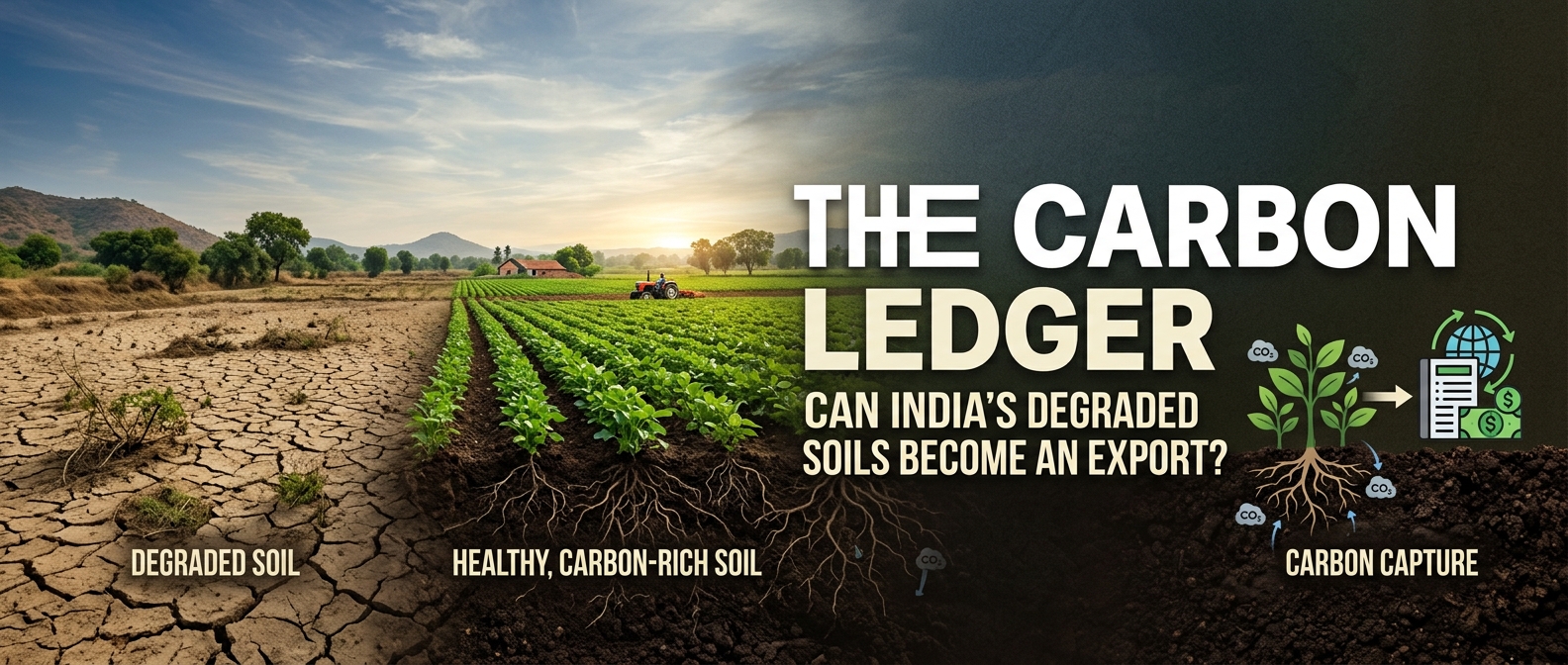
Soil organic carbon is now a tradeable commodity — the question is whether India's smallholders can actually access that market
An earlier piece in this series laid out the scale of India's soil crisis in stark terms: soil organic carbon (SOC) has fallen from roughly 1% in the 1950s to 0.3–0.4% across most farmland today, with a 2017–2023 ICAR-coordinated study confirming the decline is still active. That piece treated SOC loss purely as a liability. It's worth returning to the same number with a different question: what if rebuilding it were also a revenue line?
Soil organic carbon is now a genuine, tradeable commodity in voluntary carbon markets. A farmer who measurably increases the carbon stored in their soil can, in principle, sell that increase as a credit to a company seeking to offset its own emissions. The science, the economics, and the verification technology are all real — and all still young enough that the honest answer to “can this work for India's smallholders” is not yet at scale, but for the first time, plausibly soon.
What a Soil Carbon Credit Actually Is
The mechanism is straightforward in concept: regenerative practices — reduced tillage, cover cropping, direct-seeded rice instead of flooded transplanting, precision fertilization — increase the rate at which carbon from the atmosphere gets captured by plants and stored in soil organic matter, rather than being released back as CO₂. One verified tonne of additional CO₂-equivalent sequestered (or emissions avoided) equals one tradeable credit.
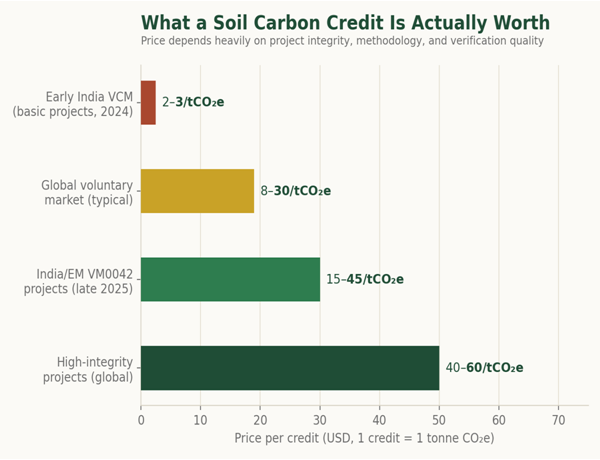
Indicative soil carbon credit pricing across market segments. Sources: industry reporting on India's early VCM projects and global voluntary carbon market data.
Price varies enormously by project integrity and verification rigor. Basic early Indian voluntary-market projects have traded as low as $2–$3 per tonne, while high-integrity projects meeting rigorous international standards have reached $40–$60 per tonne. More recent India-specific projects using Verra's VM0042 soil carbon methodology were reported, as of late 2025, in the $15–$45 per tonne range — a meaningful jump from where the market started, reflecting growing buyer confidence in Indian project quality.
India's First Real Proof Point
In January 2026, Grow Indigo's Aadi project became India's first Verra-registered, VM0042-methodology soil carbon issuance available to smallholder farmers — the first tranche covering over 50,000 credits from roughly 30,000 acres across Punjab and Haryana, built on a broader footprint of more than a million acres and thousands of participating farmers. The project's core intervention — helping farmers transition from transplanted, flooded rice to direct-seeded rice — is, not coincidentally, one of the same water-saving practices explored in the water-efficiency piece earlier in this series. Reducing flood-irrigated rice cultivation cuts methane emissions from waterlogged paddies while also cutting groundwater draw: a rare case where the carbon incentive and the water crisis point toward exactly the same on-farm change.
A separate CIMMYT and ICAR-supported project has enrolled roughly 2,000 smallholder farmers across Punjab, Haryana, and parts of Maharashtra, with researchers estimating 4 to 5 tonnes of CO₂ sequestered per participating farmer so far — modest at the individual level, but a genuine, independently verified starting point for a market that didn't exist in India at all a few years ago.
The Problem That Kept Smallholders Out
For most of the voluntary carbon market's history, soil carbon programs were built around large landholdings, for a mundane but decisive reason: verification cost.
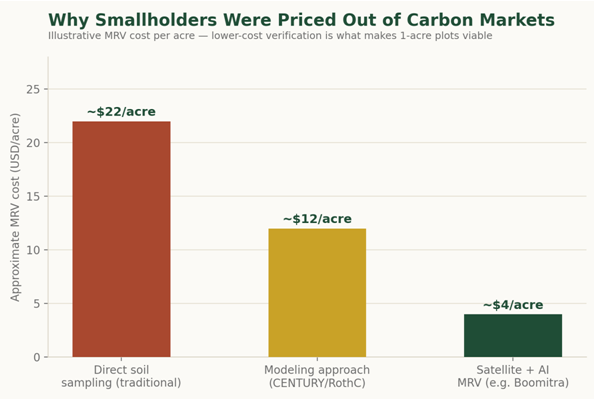
Illustrative Measurement, Reporting, and Verification (MRV) costs per acre by method. Direct soil sampling is the most accurate but least accessible approach for small plots.
The gold-standard verification method — direct physical soil sampling and laboratory analysis — costs roughly $15–$30 per acre. For a large commercial farm, that cost is trivial against the credit revenue it generates. For an Indian smallholder farming one or two acres, it can exceed the entire value of the credits the plot would generate, making participation a net loss before a single credit is sold. Modeling approaches using established soil carbon models (CENTURY, RothC) cut that cost but introduce uncertainty ranges of ±20–40% — a real scientific limitation, not just a rounding error, when the entire premise of a carbon credit is a precisely verified tonne.
This is where satellite- and AI-based MRV is starting to change the arithmetic. Boomitra, working with Social Carbon on its URVARA project in India, uses satellite imagery and machine learning to estimate soil carbon change without the cost of physical sampling at every plot — explicitly designed to make participation viable for plots as small as one acre, which the company states was historically excluded by sampling cost alone.
The Honest Tensions Nobody Should Skip Past
This is a genuinely promising direction, and it would be dishonest to present it as a solved problem. Three real tensions are worth naming directly:
- MRV accuracy is still contested. Remote-sensing and AI-based estimation is improving quickly but still requires ground-truthing with physical samples to stay credible — it is a cost-reduction technology, not yet a full replacement for verification rigor.
- Farmer transparency has been a real, documented problem. Independent investigative reporting in 2026 found farmers enrolled in at least one Indian carbon project were not clearly informed of their potential earnings or how credits tied to their land were being calculated and sold — a governance gap that has to close for smallholder trust in this market to be durable, not just for any one project's credibility.
- Aggregation is structurally hard. A single credit-worthy project needs thousands of acres to be commercially viable, which means thousands of individual smallholder agreements have to be aggregated, standardized, and tracked — an operational challenge on a scale India hasn't had to solve for any other agricultural commodity.
The technology to measure a smallholder's carbon cheaply enough now exists. Whether that farmer actually sees a fair, transparent share of what it's worth is a governance question, not a science question — and it's still open.
Sizing the Opportunity, Carefully
India's cultivable land runs to roughly 157 million hectares (about 388 million acres). Even a deliberately conservative illustrative scenario is worth walking through: if 10% of that area adopted regenerative practices generating credits at the reported VM0042 rate of roughly 1.5 credits per acre per year, at a mid-range price of $20 per credit, the resulting annual value would be on the order of $1.16 billion — before accounting for verification costs, aggregator margins, or the share that would need to flow to farmers rather than intermediaries for the model to be genuinely farmer-positive.
That number is illustrative arithmetic, not a forecast — real adoption, real MRV costs, and real price volatility would all move it substantially. But it establishes the order of magnitude: this is not a marginal side-income idea. India issued 278 million voluntary carbon credits between 2010 and 2022, 17% of global supply, almost entirely from non-agricultural sources — soil carbon from smallholder agriculture remains almost entirely untapped against that existing market infrastructure.
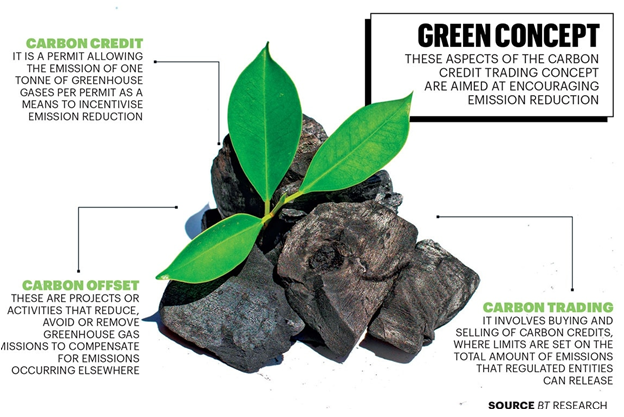
https://www.businesstoday.in/magazine/drive/story/how-carbon-credits-can-help-india-reach-its-net-zero-goals-385533-2023-06-14
Where Biological Inputs Actually Fit
This connects directly back to the science already covered in this series. The regenerative practices that generate soil carbon credits — reduced tillage, cover cropping, balanced and efficient fertilization — are exactly the practices that also rebuild the biological activity measured elsewhere in this series: microbial diversity, root exudate cycling, organic matter turnover. Biological inputs that improve nutrient use efficiency and reduce reliance on synthetic fertilizer don't just cut costs and residue risk, as covered in earlier pieces — they directly support the soil carbon accumulation that a verified credit is measuring in the first place.
None of this makes MRV easier or the governance questions less real. But it means the biological science and the carbon economics are pointing the same direction, which is a rarer alignment in agriculture than it should be — and a genuine reason to treat this as more than a passing trend.
References & Further Reading
- The Federal — What Budget 2026 Can Do to Unlock Agriculture Carbon Credits for Farmers (Grow Indigo Aadi project) — https://thefederal.com/category/farm-matters/india-soil-carbon-credits-grow-indigo-adi-227175
- Indigo Ag — Indian Farmers Unlock a New Harvest as Grow Indigo's First High-Integrity Soil Carbon Credits Reach Issuance — https://www.indigoag.com/pages/news/indian-farmers-unlock-a-new-harvest-as-grow-indigos-first-high-integrity-soil-carbon-credits-reach-issuance
- CIMMYT — Bringing Voluntary Carbon Offset Markets to Smallholder Indian Farmers — https://www.cimmyt.org/news/bringing-voluntary-carbon-offset-markets-to-smallholder-indian-farmers/
- Boomitra — Boomitra and Social Carbon Announce Landmark Soil Carbon Credit Issuance from Smallholder Farmers in India — https://boomitra.com/landmark-urvara-issuance-india/
- Solar Tech Online — Soil Carbon Credits: Complete 2025 Guide for Farmers & Buyers (MRV cost and market-size data) — https://solartechonline.com/blog/soil-carbon-credits-guide/
- Costmos — How Much Is 1 Carbon Credit Worth in India? — https://costmos.in/how-much-carbon-credit-worth-in-india/
- Open Library (Substack) — A Guide to Carbon Credits for Farmers and Individuals in India — https://openlibrary.substack.com/p/a-guide-to-carbon-credits-for-farmers
- iSignal — Farmers Part of Projects Under Voluntary Carbon Markets Say They Have Not Been Informed of Potential Earnings From Credits — https://www.isignal.in/investigations/the-communication-gap-thats-plaguing-private-carbon-farming-988266
Note: carbon credit pricing is volatile and varies by methodology, registry, buyer, and project vintage; the illustrative market-sizing calculation above uses simplified, rounded assumptions to establish order of magnitude and should not be read as a financial projection. MRV science for soil carbon, particularly remote-sensing-based approaches, remains an active area of research and standard-setting.