
HOW A BILLION BACTERIA DECIDE TO ACT AS ONE
- BioPrime Stories & latest news

- HOW A BILLION BACTERIA DECIDE TO ACT AS ONE
HOW A BILLION BACTERIA DECIDE TO ACT AS ONE
Quorum sensing, and why the same biological product performs differently in every field it's used in
A single bacterium is, by most meaningful measures, powerless. It cannot sense its environment with any sophistication, cannot mount a coordinated defense, cannot build the structural biofilm that would let it survive a hostile surface. And yet bacteria collectively perform some of the most complex coordinated behavior in biology — because they've solved a problem most people don't realize needs solving: how do you know, as a single cell with no eyes and no brain, how many of your own kind are around you?
The answer is one of the more elegant discoveries in modern microbiology, called quorum sensing — and it turns out to explain something that puzzles a lot of farmers directly: why the exact same biological product, applied the exact same way, performs differently from field to field.
The Bacterium That Only Glows in a Crowd
The story starts in the 1970s with Woody Hastings, a Harvard biochemist studying an obscure marine bacterium called Vibrio fischeri, which lives symbiotically in the light organs of certain fish and squid. Hastings and his student Kenneth Nealson noticed something strange: the bacterium only produced light — bioluminescence — once its poopulation reached a certain density. Grow it in a dilute culture and nothing happens. Let it multiply past a threshold and the entire population lights up in near-unison.
The experimental detail that gave the game away: bioluminescence increased far faster than cell division could explain — cells would double in number, but light output would jump tenfold in the same window. That mismatch told Hastings and Nealson something was accumulating in the environment alongside the growing population, and once it built up enough, it triggered a switch. They called this substance an autoinducer.
The molecular mechanism, later worked out in detail, is genuinely elegant: an enzyme called LuxI continuously produces the autoinducer molecule (a homoserine lactone), which diffuses freely in and out of the cell. At low population density, the molecule diffuses away into the environment as fast as it's made. As the population grows, autoinducer accumulates faster than it can disperse — and once its concentration crosses a threshold (measured in nanomoles), it binds a receptor protein called LuxR, which switches on the genes for bioluminescence, all at once, across the whole population.
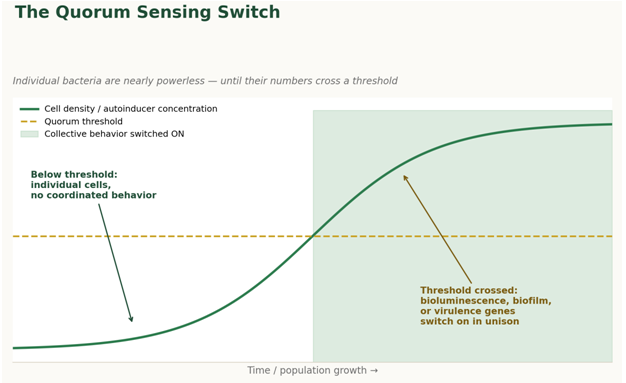
The quorum sensing switch: autoinducer concentration tracks population density, and collective behavior activates only once a threshold is crossed.
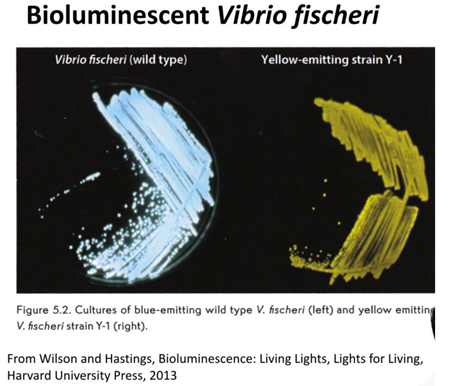
From One Glowing Fish Symbiont to All of Microbiology
The real significance of this discovery only became clear decades later, largely through the work of Bonnie Bassler at Princeton. Bassler discovered that the bacterium Vibrio harveyi uses not one but two autoinducers: the species-specific one Hastings had found (renamed AI-1), and a second, structurally different molecule she called autoinducer-2 (AI-2) — a signal shared across many different bacterial species, functioning almost like a universal language layered on top of each species' private dialect.
Bassler's subsequent work showed quorum sensing is not a quirky exception restricted to bioluminescent marine bacteria — it is the norm across the bacterial world. Bacteria use these signals to distinguish self from other, to coordinate behavior with closely related neighbors while ignoring distant ones, and — critically for agriculture — to decide collectively when to form a biofilm, when to switch on virulence factors, and when it's worth the metabolic cost of mounting a coordinated group response at all.
A bacterium doesn't decide to attack, defend, or build a biofilm alone. It waits until enough of its neighbors agree the moment has come — and quorum sensing is the mechanism by which that agreement happens.
Why This Matters in the Rhizosphere
The zone immediately around a plant root — the rhizosphere — is one of the most quorum-sensing-active environments in nature, and for a very practical reason: plant growth-promoting rhizobacteria (PGPR) need to establish a large enough population on the root surface before it's worth switching on the traits that actually help the plant — antifungal compound production, nitrogen fixation efficiency, biofilm formation that protects the root from pathogens.
Research reviewing rhizobacterial signaling has found that quorum sensing directly influences root colonization success, nutrient uptake, nodulation efficiency, plant hormone production, and even the plant's own defense gene expression. One striking finding: a PGPR strain of Bacillus subtilis was shown to alter the nodulation efficiency of Sinorhizobium meliloti on alfalfa roots — not by competing with it directly, but by interfering with its quorum sensing signal. One microbe's population-counting mechanism can be manipulated by another microbe entirely.
Why a Bottle of the Same Product Behaves Differently in Every Field
This is the direct, practical payoff for anyone using biological inputs. A microbial product introduced into soil doesn't act in isolation — its ability to reach quorum, and therefore switch on its beneficial behavior, depends on the resident microbial community already present in that specific field. A soil with a dense, competitive microbiome may dilute or interfere with an introduced strain's ability to reach the population density its quorum sensing system requires. A soil with more open niche space may let the same strain establish and activate quickly. Same product, same dose, same crop — genuinely different outcome, because the quorum-sensing math is different in every field.
Quorum Quenching: Turning the Same Mechanism Into a Biocontrol Tool
If bacteria can be tricked into switching on collective behavior, they can also be tricked into staying quiet — a strategy called quorum quenching (QQ). Three mechanisms dominate the literature:
- Enzymatic degradation. Lactonase enzymes (such as AiiA) and acylases directly break down the autoinducer signal molecule before it can accumulate to threshold concentration.
- Signal mimicry. Molecules that resemble the real autoinducer occupy the receptor without activating it, effectively jamming the channel.
- Natural plant defense. Plants themselves produce quorum-quenching molecules as secondary metabolites — the same category of “information carrier” compounds explored earlier in this series — specifically to interrupt pathogen biofilm formation before it becomes established.
This has already moved into real biocontrol applications: quorum quenching has been used as a control strategy against bacterial soft rot, one of agriculture's more damaging post-harvest diseases, by preventing the pathogen population from ever reaching the density at which it switches on its destructive enzymes. It's a fundamentally different strategy from killing the pathogen outright — it simply keeps the population below the threshold where it becomes dangerous.
The Practical Takeaway
Quorum sensing reframes something that's easy to misread as inconsistency into something that's actually predictable, once you know to look for it. A biological product's performance depends not just on what's in the bottle, but on whether the introduced organisms can reach the population density their own genetics require before they'll do anything useful — which depends on the soil's existing microbial competition, not just the product's formulation.
This is precisely why serious microbial discovery work — building a strain library across many soil types, characterizing how candidate strains behave under realistic microbial competition rather than sterile lab conditions — matters more than screening for a single "best" strain in isolation. A microbe that reaches quorum easily in one soil's competitive landscape may never get there in another, and no amount of product reformulation changes that; only understanding the biology, field by field, does.
References & Further Reading
- HHMI — Bonnie Bassler Is Tapping Into Bacterial Conversations — https://www.hhmi.org/news/tapping-bacterial-conversations
- PNAS — Profile of Bonnie L. Bassler — https://www.pnas.org/doi/10.1073/pnas.0705870105
- Journal of Bacteriology — Lighting the Way: How the Vibrio fischeri Model Microbe Reveals the Complexity of Earth's “Simplest” Life Forms — https://journals.asm.org/doi/10.1128/jb.00035-24
- ASBMB Today — Tapping Into Bacterial Conversations — https://www.asbmb.org/asbmb-today/science/011825/tapping-into-bacterial-conversations
- PMC — Noise and Crosstalk in Two Quorum-Sensing Inputs of Vibrio fischeri — https://www.ncbi.nlm.nih.gov/pmc/articles/PMC3224347/
- ScienceDirect — Unraveling the Secrets of Rhizobacteria Signaling in the Rhizosphere — https://www.sciencedirect.com/science/article/abs/pii/S2452219822000143
- PubMed — Role of Bacterial Quorum Sensing in Plant Growth Promotion — https://pubmed.ncbi.nlm.nih.gov/39724256/
- bioRxiv — Quorum Quenching Activity of PGPR Bacillus subtilis UD1022 Alters Nodulation Efficiency of Sinorhizobium meliloti on Medicago truncatula — https://www.biorxiv.org/content/10.1101/2020.08.26.268953.full.pdf
- ScienceDirect — Stopping Not Till the Rot Rots: Quorum Quenching as a Biocontrol Method for Soft Rot Control in Agriculture — https://www.sciencedirect.com/science/article/abs/pii/S1878818124000811
- Springer, Discover Plants — Exploring the Potential of Rhizosphere Microbial Biofilms for Promoting Plant Growth — https://link.springer.com/article/10.1007/s44372-026-00606-z
Note: quorum sensing mechanisms vary meaningfully across bacterial species and genera; the Vibrio fischeri LuxI/LuxR system described here is the best-characterized model system and is used for clarity, but rhizosphere PGPR species often use structurally different autoinducers and regulatory circuits, as reflected in the broader review literature cited above.