
The Intensifying Fertilizer Crisis in India
- BioPrime Stories & latest news

- The Intensifying Fertilizer Crisis in India
The Intensifying Fertilizer Crisis in India
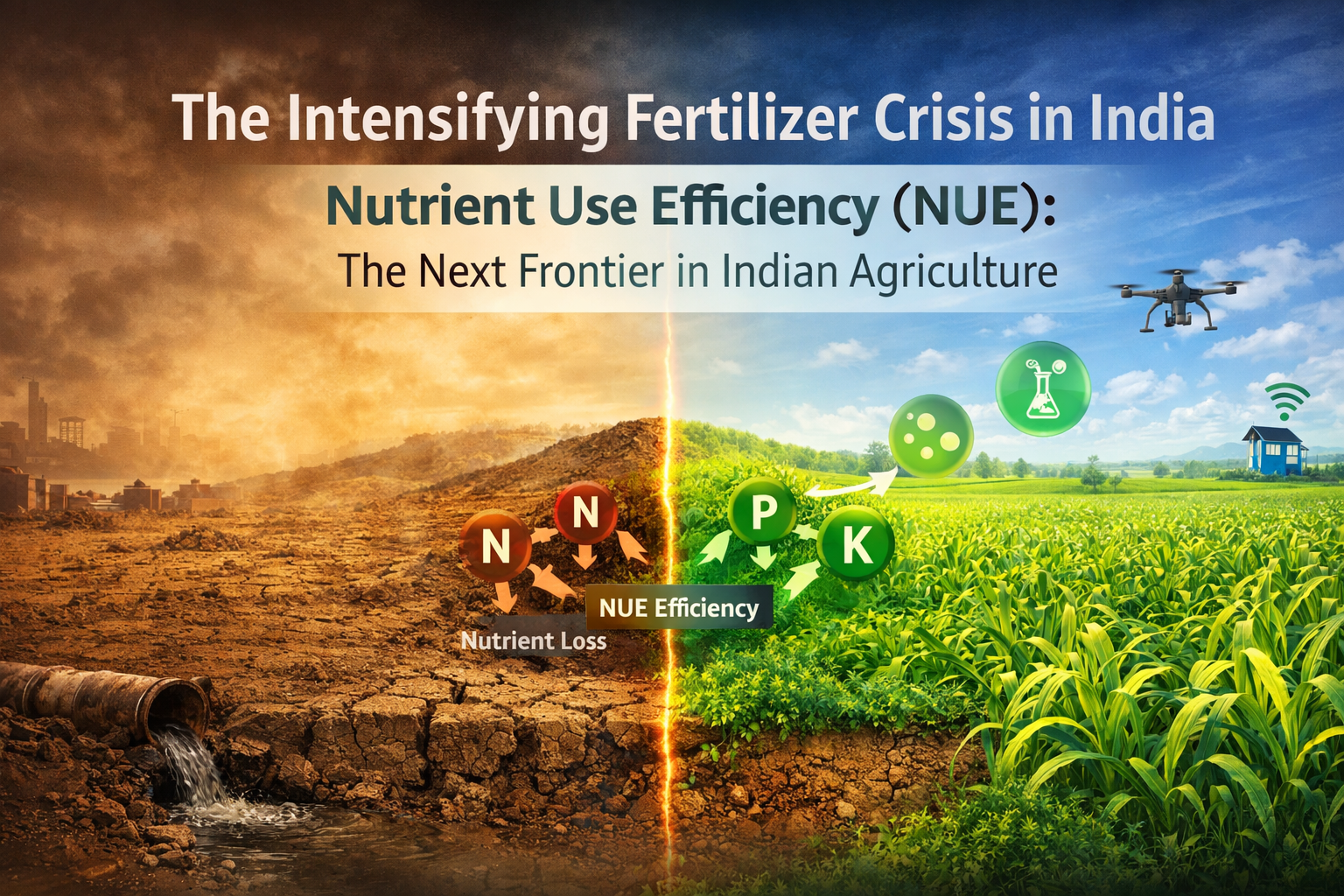
Nutrient Use Efficiency (NUE): The Next Frontier in Indian Agriculture
India's agricultural success has long been measured in yield per acre. But today, the real question is more fundamental: how efficiently are we using what we already apply?
This is where Nutrient Use Efficiency (NUE) becomes critical — and why it is emerging as the next defining frontier for Indian agriculture. The answer, increasingly, lies not in adding more inputs, but in making every kilogram of fertilizer work harder through the power of biology.
The Core Problem: Low Efficiency, High Dependence
Globally, NUE remains below 30%. In simple terms, more than two-thirds of applied fertilizers are lost — to the air, to water bodies, or locked up in the soil in forms that plant roots simply cannot access.
In India, the situation is even more acute, shaped by a combination of structural and behavioural patterns:
- Heavy reliance on subsidised fertilisers, especially urea
- Skewed N:P:K application ratios that ignore crop-specific needs
- A deeply entrenched 'more input = more yield' mindset among farming communities
The result is a paradox:
- Higher costs of inputs
- Stagnating yields, and
- Steadily declining soil productivity
— all driven by the very inputs meant to support growth.
Soil Health: The Silent Casualty
The consequences of long-term over-application go far beyond a single season's inefficiency. Years of indiscriminate fertiliser use have fundamentally altered the biological and chemical character of India's agricultural soils:
- Nutrient imbalances — excess nitrogen alongside severe deficiencies in secondary and micronutrients
- Declining organic carbon — reducing the soil's capacity to hold water, buffer pH, and sustain life
- Reduced microbial diversity — collapsing the biological networks that drive nutrient cycling
- Lower nutrient buffering capacity — making soils less resilient to application irregularities
What once powered the yield gains of the Green Revolution is now eroding the very foundation of productivity. This is not just a soil problem — it is a system-level inefficiency that compounds with every season.
Put simply: India is paying more to get less — while simultaneously degrading the ecosystems that agriculture depends on.
The Tipping Point: The Law of Diminishing Returns
Fertiliser response follows a well-understood agronomic curve. In the initial phase, every additional kilogram of nutrient drives strong yield gains. As application approaches the optimal zone, efficiency peaks. Beyond that point, the curve flattens — and then declines.
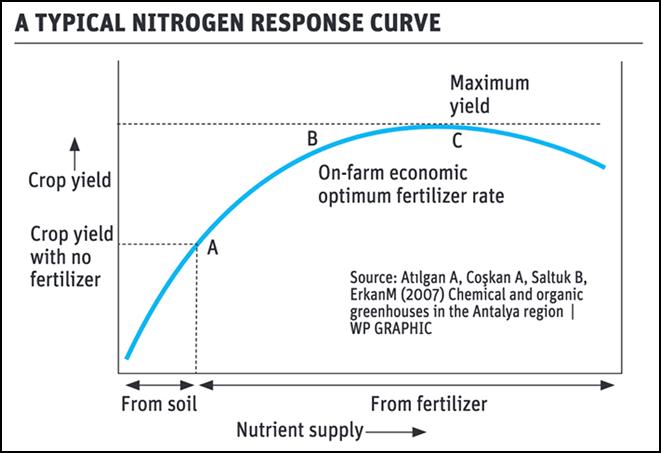
In practical terms, this manifests as:
- Excess nitrogen driving vegetative growth at the expense of grain yield
- Excess phosphorus locking up micronutrients like zinc and iron through antagonism
- Over-application leading to phytotoxicity and measurable yield loss
Economically, the tipping point is reached when the cost of additional fertiliser exceeds the value of any incremental yield gained. In India, many cropping systems have already crossed this threshold — yet application rates continue to rise. The feedback loop is broken.
The real question therefore is how do we achieve balanced nutrition and transition from input intensity to input intelligence?